
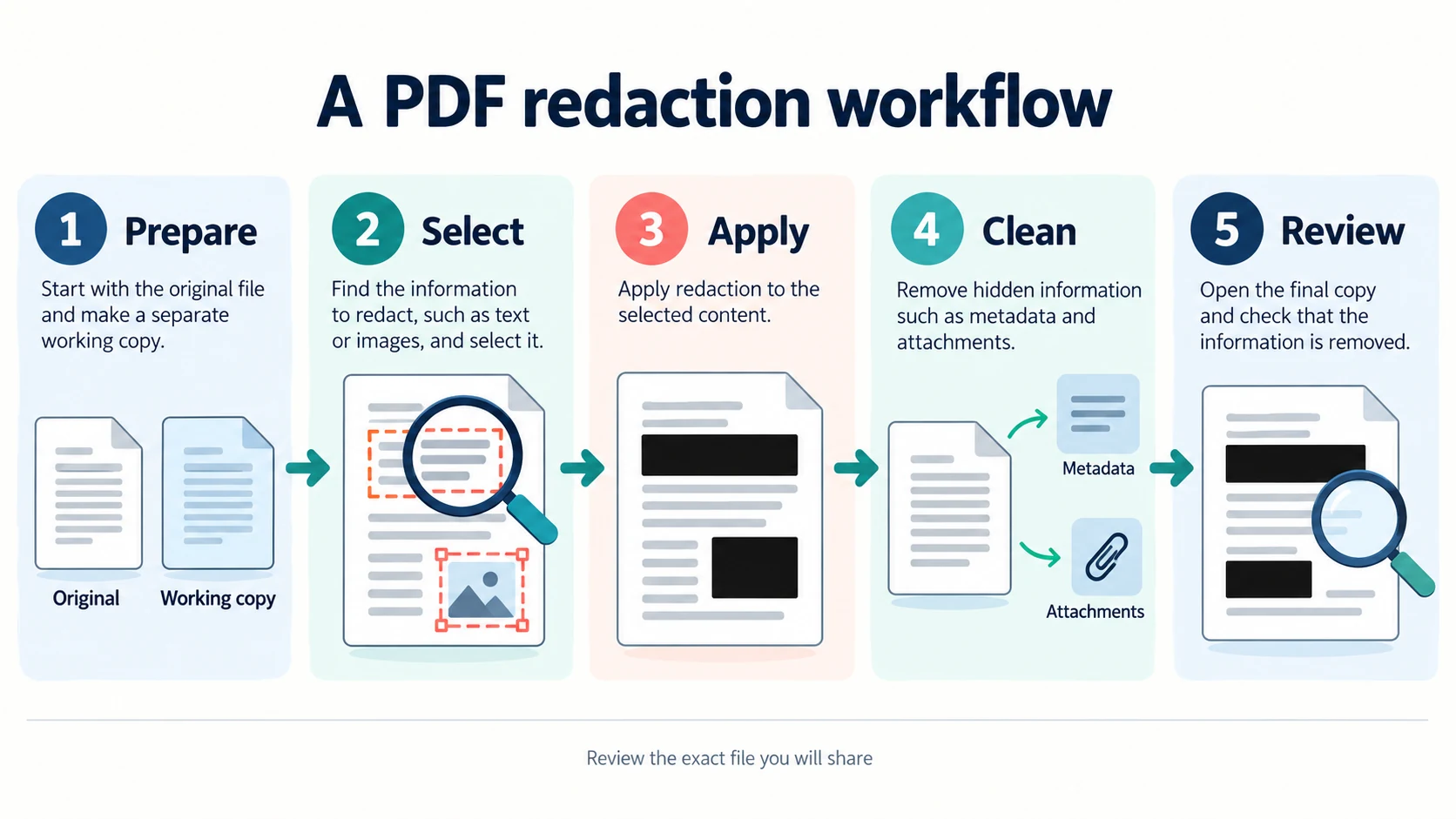
To redact a PDF, identify the information that must be removed, mark it with a dedicated redaction tool, apply the removal, and save a separate final copy. Then deal with hidden information and review the file you will actually send.
The careful part is deciding what belongs in that final copy. A name can appear in a paragraph, a scanned attachment, a comment, and the document properties. Removing one visible occurrence can leave the others untouched.
I’ll take you through that complete workflow, including Acrobat, Mac Preview, online tools, and the checks that matter before sharing.
Correction: An earlier version of this guide treated markup and overlay boxes as content removal and overstated security and undo claims. A visual cover alone does not establish removal. Applied and saved redactions should be treated as permanent.
Key takeaways
- Decide what you are allowed to share before choosing the tool or marking the document.
- Keep a protected original and work on a separate copy with a clear filename.
- Selection marks are an intermediate step. Finish the tool’s Apply, Finish, or equivalent removal process.
- Search can help with repeated text, but images, scans, spelling variations, and hidden content need separate attention.
- Review the saved output. A clean-looking page or an unsuccessful text search does not certify that the entire file is safe to disclose.
What redacting a PDF actually removes
A proper PDF redaction feature removes selected content from the resulting document. A drawing tool can instead add an object over the page, leaving the content underneath.
Adobe explains this distinction for its redaction tools. The black or colored area you see is the finished appearance of the redaction, rather than evidence that any ordinary rectangle will do the same job.
There are three jobs to keep in mind:
- Redaction: remove the selected visible information.
- Sanitization: remove unwanted hidden information, such as metadata or embedded content.
- Access control: control who receives or can open the document.
A password can help with access, but it does not decide which information a permitted recipient should see. Likewise, removing a sentence does not clean every other part of the file.
If your immediate goal is a small text removal, our guide to blacking out PDF text with real redaction focuses on that task. The workflow here covers the broader document review.
Prepare your original and decide what to remove
I recommend writing a short removal checklist before opening the editor. It gives you something concrete to compare with the finished document.
For example, if you need to share a sample invoice, the checklist might include the customer’s name, address, email, account reference, and signature. That is an example, not a rule that every invoice needs those details removed. Your purpose and permission determine the scope.
- Confirm the audience. Decide who needs the document and what information they actually need.
- Preserve the original appropriately. Keep it in a location suitable for its sensitivity and any retention requirements.
- Create a working copy. A name such as example-working.pdf helps distinguish it from the original.
- Plan the final filename. Use a separate name such as example-redacted.pdf, without putting confidential details in the filename itself.
- Check the whole document. Include appendices, screenshots, headers, footers, and additional files attached inside the PDF.
If the document is locked, signed, or subject to a formal disclosure process, ask its owner or responsible team for an authorized workflow. Don’t strip restrictions or alter an official record just to make a redaction tool work.
Choose a redaction method that fits your file
The right choice depends on the document’s content and where you are allowed to process it.
- Acrobat desktop: useful when you need manual selection, repeated-text search, image redaction, and hidden-information removal in one workflow. Adobe lists its redaction tutorial for Pro, Premium, or Studio.
- Mac Preview: a built-in option for text redaction. Its documented Redaction Selection feature should not be treated as an all-purpose scan and metadata cleanup tool.
- A dedicated online redactor: an option when the service is suitable for the file and your sharing permissions. Check its processing and privacy details first.
- An organization’s approved tool: the starting point for confidential work records or any document that needs formal review.
For me, the important question is whether the workflow handles every kind of content that needs removal. Free access or a familiar app icon does not answer that question.
How to redact a PDF in Adobe Acrobat
These desktop steps follow Adobe’s redaction instructions. Older interfaces can use different labels.
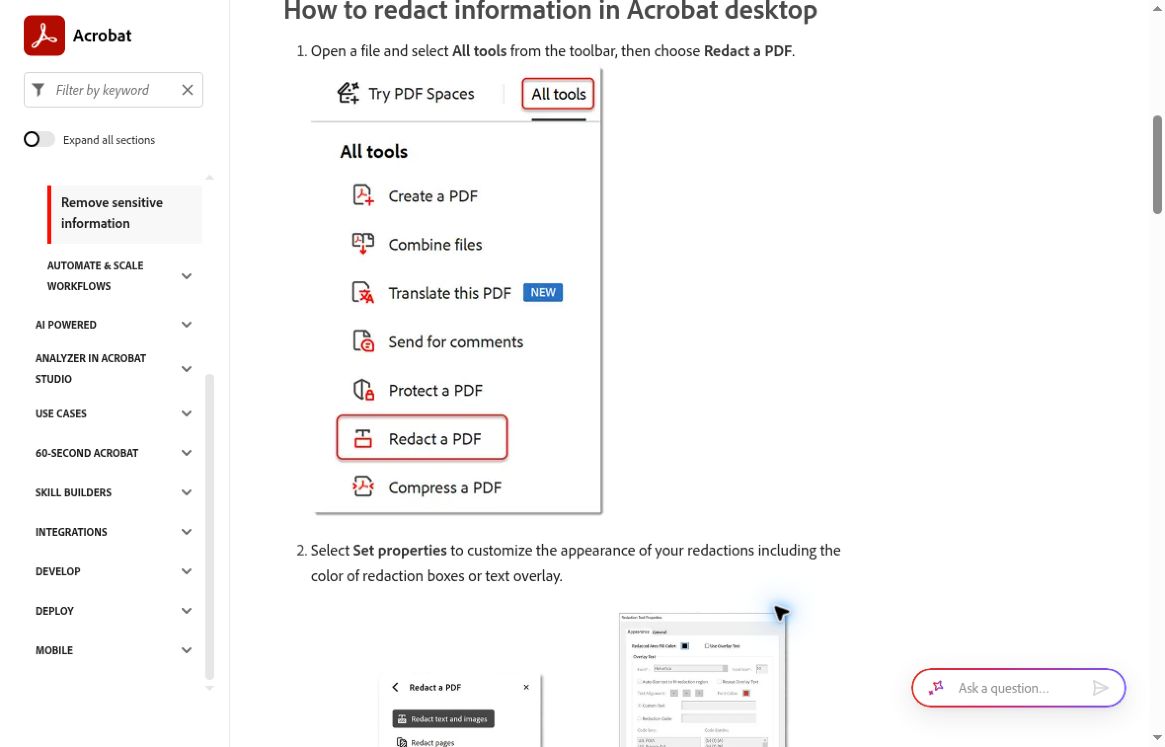
- Open the working PDF and choose All tools > Redact a PDF.
- Select Redact text and images.
- Drag over the content you want removed. Review the boundaries of each selection.
- When your selection review is complete, choose Apply.
- Review the option to sanitize and remove hidden information. Choose it when appropriate for the intended copy.
- Select Continue, enter a separate filename and location, and save the result.
Marking is preparation for removal. Don’t send a file just because you can see redaction marks in the editor.
Adobe describes applied and saved redactions as permanent. Review selections first, and keep the original separate rather than relying on an undo shortcut.
Find repeated text before applying redactions
For a long document, Acrobat’s Find text and redact workflow can locate a word, several terms, or supported patterns.
- From the redaction tools, open Find text and redact.
- Choose the search type and the document or location to search.
- Run the search and inspect the matches. Choose the occurrences that should be removed.
- Set whole-word or partial-word marking as needed, then mark the checked results for redaction.
- Return to the redaction panel to review and apply the marked removals.
I would search variations too. A fictional customer called Alex Morgan might appear as A. Morgan elsewhere. A reference number might contain spaces or punctuation on another page.
Use search to help you find candidates, then read the surrounding context. Selecting every match without looking can remove information you meant to keep while missing a differently written version.
Select images and whole pages deliberately
Words inside a screenshot, a signature image, or a photographed page may need image-area redaction. Adobe’s image-redaction instructions describe selecting the redaction tool and double-clicking an image to mark the entire image, followed by applying and saving.
If only a portion should be removed, use the appropriate area-selection workflow and inspect what is marked. Don’t assume that selecting nearby text also handles the image.
Adobe’s illustrated tutorial also documents whole-page redaction and appearance settings. An overlay label can explain a completed redaction, but typing “Private information” over a page is not itself removal.
How to redact a PDF on Mac with Preview
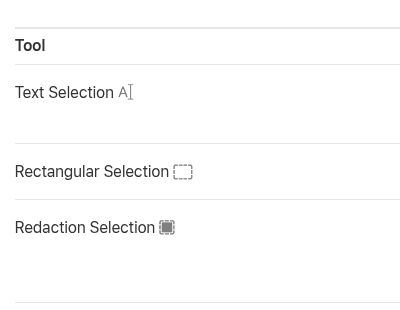
Open a separate copy in Preview, show its Markup toolbar, and choose Redaction Selection. Select the text you need to remove and review the selections before saving and closing the document.
Apple’s Preview guide distinguishes that tool from Rectangular Selection and Shapes. It says redactions can be changed during editing but become permanent after you close the document.
Reopen the saved copy for review. If you need to remove image regions, deal with a scan, or clean hidden information, choose a workflow that explicitly supports those requirements. Apple’s text-redaction instructions do not establish that Preview sanitizes the entire file.
How to redact a PDF online
Before choosing a file, check whether the service processes it locally or sends it to a server, what it retains, and whether you have permission to use it for this document. Work records may need an approved service even when a public tool advertises encryption.
A browser-based editor’s drawing button is not enough. Look for a dedicated redaction feature with a documented finalization step.
For example, Smallpdf’s redaction page describes choosing its Redact icon, selecting text or areas, selecting Finish, and downloading the output. Those are the provider’s instructions, not a claim that I tested confidential documents there.
After downloading, open the file from your downloads folder and run the review checklist below. Don’t rely only on the site’s preview.
Check what the online tool does to your PDF
Different services can produce different kinds of output. PDF24 says its dedicated redaction tool converts affected pages to raster images when saving. That specific processing step is why its shapes-based interface should not be confused with drawing an ordinary PDF annotation.
For image-based output, check whether the result still meets your needs for readable text, searching, copying, and accessibility. A file that looks acceptable on screen may be less useful to its recipient.
I recommend an approved local workflow when you cannot establish whether a web service is appropriate for the original information. Avoid uploading the same sensitive file to several sites just to compare their interfaces.
Handle scanned PDFs and OCR carefully
A scan can look like ordinary text while containing only page images. Other scanned PDFs also have an OCR text layer, which makes the words searchable.
Adobe’s OCR instructions explain that text recognition creates a searchable layer and that you should review its accuracy. OCR helps locate information; it does not redact it.
- Check whether text selection and search work on each relevant page.
- If needed, run OCR in a suitable, approved tool before using text searches to find candidates.
- Visually inspect the scans for missed or incorrectly recognized details.
- Use a redaction workflow that handles the sensitive image area and any associated text.
- Review the saved result again, including pages with handwriting, rotated text, stamps, or small print.
iLovePDF’s dedicated tool also prompts for OCR when selectable text is missing. Treat this as a clue about the document, not a reason to assume every visible word will then be detected.
If search finds nothing in the original scan either, finding nothing in the final file tells you very little. Use visual review alongside the tool’s documented removal process.
Remove hidden information from the sharing copy
A PDF can contain more than the page you are looking at. Adobe’s list of redactable data includes document properties, attachments, bookmarks, comments, form information, hidden text, hidden layers, and cropped content.
Use that as a separate checklist. For example, removing a person’s name from a page would not be sufficient if the same name remained in a comment or an attached original document.
In Acrobat, Sanitize document is available within the redaction tools. Adobe documents both removing all hidden information and selectively removing categories through the Hidden Information panel.
Review the choices against the document’s purpose, remove what should not be shared, and save the cleaned output. Then check that useful content and required functionality still remain.
Do this on the intended sharing copy. Keep any original that must be retained under the appropriate access and retention rules.
Understand the limits of Word, phone markup, and whiteout
Prepare a clean Word source before exporting
If you own the Word source, you can prepare a separate version with the unwanted content actually removed. Review tracked changes and comments so an edit is not merely hidden.
Microsoft’s Document Inspector guidance covers several hidden-data categories and recommends working on a copy. In supported desktop Word versions, the route is File > Info > Check for Issues > Inspect Document.
Review the inspection results and the document before exporting. Microsoft also warns that the inspector cannot detect objects covered by other objects. A rectangle over a sentence is therefore a poor substitute for removing the source content.
Inspect the exported PDF too. Source cleanup helps, but Document Inspector is not a certificate for the final PDF.
Check the exact phone app and feature
Phone markup tools are useful for comments and drawings. Apple’s iPhone Preview guide describes highlighting and adding shapes, text, and other annotations. Those operations do not establish that confidential content has been removed.
Choose an app with documented redaction for your device, or complete the task with a suitable desktop tool. Don’t transfer Mac instructions to a phone merely because the apps share a name.
Avoid shortcuts that only change the page appearance
A white box, blur, highlighter stroke, cropped view, or flattened annotation can change how information looks without establishing what the file retains. Print to PDF alone is not a dependable sanitization procedure.
A product may use “whiteout” for a genuine removal feature, while another uses it for a visual cover. Foxit’s redaction guide, for example, describes its Whiteout feature as permanent removal. Read the documentation for your exact feature and finish its removal process.
Our guide to drawing on a PDF is useful when you need annotations. For confidential disclosure, use the redaction workflow described here.
Review the final PDF before you send it
I recommend a fresh review after the file has been saved and reopened. This helps separate checking your decisions from making edits.
- Compare with your removal checklist. Check every intended category, not only the areas you remember selecting.
- Read every page. Inspect headers, footers, tables, pictures, appendices, and repeated details.
- Search locally for removed terms and variations. Our PDF search guide explains common Find controls.
- Try selecting and copying from the redacted regions. Use an appropriate local editor for the check, rather than pasting sensitive material into a public service.
- Inspect hidden-information categories. Check the properties, comments, attachments, and other content relevant to your file.
- Read what remains. Confirm that the recipient can still understand the document and that nearby details do not disclose information you intended to withhold.
- Check the actual attachment or sharing link. Confirm that it points to the reviewed final copy, not the working copy, original, or a folder containing both.
These are practical error-catching checks. Passing them does not prove that no recoverable information remains in every PDF structure, nor that your disclosure choices meet a particular legal requirement.
For consequential disclosures, use the organization’s approved process and arrange an appropriately qualified second review. If you cannot verify a part of the file, pause before sending it.
Frequently asked questions
Can I redact a PDF for free?
Mac Preview includes the documented text-redaction feature described above. Some online services also offer free redaction, but limits and terms can change. Choose based on the file’s requirements and privacy constraints, then review the saved output.
Can I undo a PDF redaction?
You may be able to change pending selections before finalizing them. Don’t rely on undo after removal. Adobe describes applied and saved redactions as permanent, and Apple says Preview redactions become permanent when the document is closed. Correct mistakes from a separately protected original.
Why can’t I select the text I want to redact?
The page may be a scan or image without selectable text. Your app may also lack the required feature, or the file may have editing restrictions. Identify the cause, use suitable OCR or image redaction where appropriate, and obtain an authorized editable copy when permission is the issue.
Does a black box mean the PDF is redacted?
No. It might be an annotation covering underlying content, a pending mark, or the visible result of completed redaction. You need to know which feature created it and whether the removal process was completed.
Should I redact before or after converting Word to PDF?
If you control the source, prepare and inspect a clean Word copy first, then review the exported PDF. You can also use a dedicated PDF redactor on the export. Either way, check the final file instead of assuming that an earlier edit carried through correctly.
Can I use an online redactor for confidential files?
Only when the service and its processing arrangements fit the information and your permission to use it. Check current privacy details and any workplace requirements. If those are unclear, use an approved local workflow or ask the responsible team before uploading.
Final thoughts
A reliable redaction routine starts before the first selection and ends with the exact file you share. Decide what must go, use a documented removal feature, finalize the changes, address hidden information, and review the output.
Keep the original separate throughout. That gives you a controlled way to fix a mistake without depending on reversing a completed redaction.