
Instagram in 2026 isn’t powered by one “algorithm.” It’s a set of ranking systems that decide what each person sees across Feed, Stories, Reels, Explore, and Search. The goal is simple: show each user the content they’re most likely to enjoy right now—and keep them coming back.
Here’s the practical takeaway: you don’t “beat” the algorithm. You align your content with the signals Instagram uses to predict satisfaction. When your content consistently drives the right signals (watch time, saves, shares, meaningful comments, profile actions), Instagram confidently shows it to more people.

The biggest shift in 2026: signal accuracy > trends
Trends still matter, but Instagram has gotten better at measuring whether a piece of content genuinely satisfies viewers. In other words, a trending audio can help you get initial distribution, but retention and engagement quality determine whether you keep getting pushed.
That’s why creators who focus on clarity, relevance, and audience fit are outperforming accounts that chase every trend.
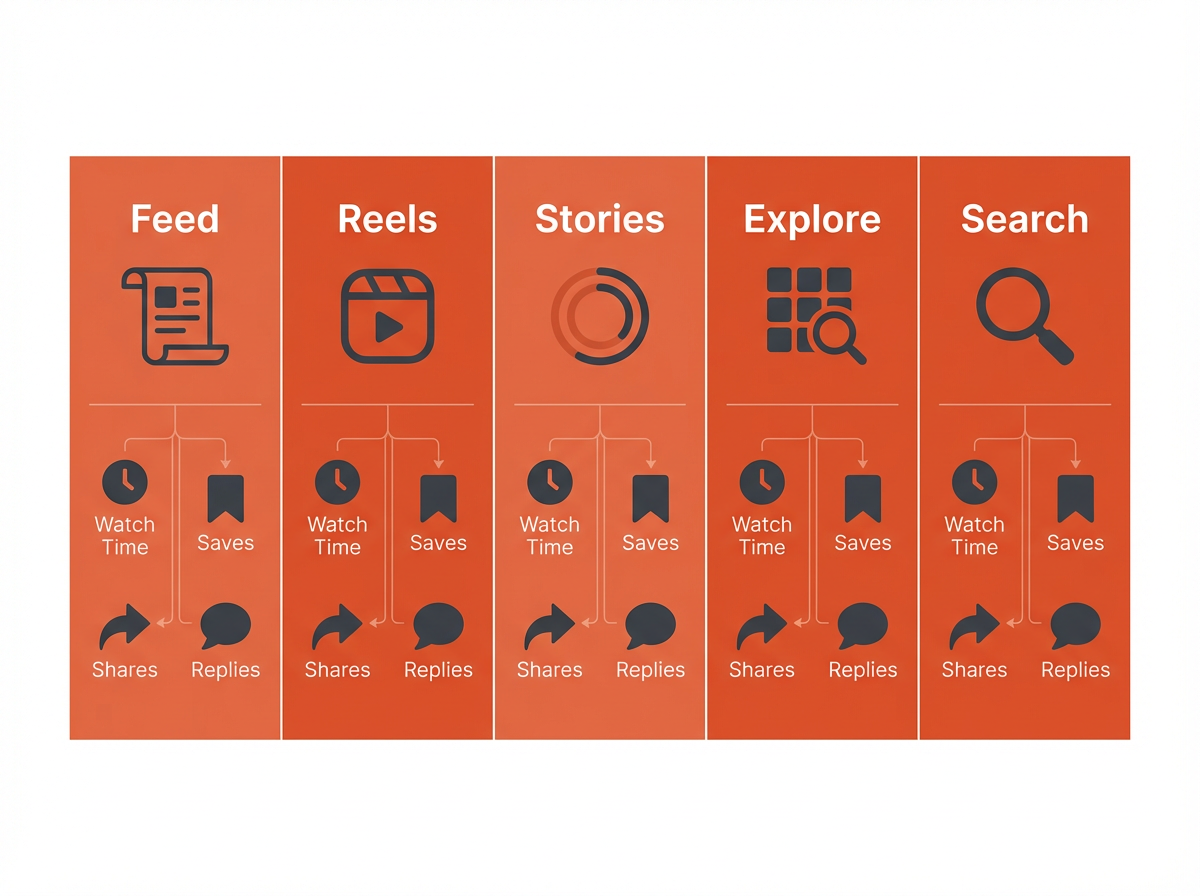
What Instagram is optimizing for (by surface)
- Feed: relationship + interest + likelihood to engage (save/comment/share) + time spent
- Stories: relationship + completion rate + replies + taps (link, sticker, profile)
- Reels: watch time + replays + shares + saves + follows after viewing
- Explore: predicted interest based on similar content you’ve engaged with
- Search: keyword relevance + engagement + account/topic authority
Core ranking signals Instagram uses in 2026
If you want to understand how the Instagram algorithm works in 2026, focus on the signals that show Instagram your content is worth distributing. These signals vary by format, but the themes are consistent.
1) Watch time and retention (especially for Reels)
Instagram heavily weights whether people keep watching. A Reel that holds attention to the end—or gets rewatched—sends a strong satisfaction signal.
2) Saves and shares (high-intent engagement)
Saves and shares are “strong votes.” A like is nice, but a save says, “This is valuable.” A share says, “This is worth recommending.” Both are distribution accelerators.
3) Meaningful comments and DMs
Not all comments are equal. Longer, specific, conversational comments tend to indicate higher value. DMs (like “send me the link” or “this helped”) can also correlate with strong content-market fit.
4) Relationship signals
Instagram prioritizes content from accounts a user interacts with often—comments, DMs, Story replies, profile visits, and time spent on your posts all contribute.
5) Interest matching (topic modeling)
Instagram categorizes content by topic using captions, on-screen text, audio, hashtags, and engagement patterns. The better your content clearly fits a topic, the easier it is to match you to the right audience.
6) Account trust and consistency
Accounts that consistently publish original, guideline-compliant content—and avoid spammy behavior—tend to get more stable distribution over time.
How ranking works by placement: Feed, Stories, Reels, Explore, and Search
Let’s make this super practical. Each placement has its own “job,” and your content should be designed to win in that environment.
Feed algorithm in 2026
Feed is where Instagram balances relationship content (friends, creators you follow) with content it believes you’ll enjoy. Feed rewards:
- Strong first-frame visuals (stopping the scroll)
- Carousels that encourage swipes (time spent + completion)
- Posts that spark comments and saves
Stories algorithm in 2026
Stories are relationship-first. Instagram shows Stories from accounts you interact with most. Stories reward:
- Consistency (showing up daily or near-daily)
- Replies and sticker taps (polls, questions, quizzes)
- Completion rate (people not tapping away)
Reels algorithm in 2026
Reels are discovery-first. This is where non-followers can find you fastest. Reels reward:
- Hook + retention (first 1–3 seconds matter)
- Rewatches (tight edits, loops, satisfying endings)
- Shares/saves (useful, entertaining, or identity-based content)
- Follows after viewing (strong indicator you’re a good recommendation)
Explore algorithm in 2026
Explore is interest-first. It’s built to help users discover new accounts based on what they already like. Explore rewards:
- Content that performs well with your “adjacent audience”
- Clear topic signals (caption keywords, on-screen text, hashtags)
- High engagement rate relative to your typical baseline
Search algorithm in 2026 (yes, SEO matters)
Instagram Search has become more keyword-driven. People search for “meal prep high protein,” “wedding photographer Chicago,” “Pilates for beginners,” and Instagram tries to serve relevant accounts and posts. Search rewards:
- Keywords in name, bio, captions, and alt text
- Strong engagement and watch time (proof of relevance)
- Consistent topical authority (posting about the same themes)
20 actionable tips to work with the Instagram algorithm in 2026
These are designed to be practical. Pick 5 to implement this week, then stack more as you go. The key is consistency and iteration.
Tip 1: Optimize for “saves” with repeatable frameworks
If you want algorithm-friendly content, create posts people want to keep. Try:
- Checklists (“7-step launch checklist”)
- Swipeable templates
- Before/after breakdowns
- “Do this, not that” carousels
Action: Add a line near the end: “Save this for later when you’re ready to implement.”
Tip 2: Win the first 3 seconds (Reels) with a clear promise
In 2026, your hook isn’t just “be interesting.” It’s “be instantly understandable.”
Action: Use on-screen text that states the outcome: “3 ways to get more Story replies” or “Fix this to double Reel retention.”
Tip 3: Build loopable Reels to earn replays
Replays are a strong satisfaction signal. Loops happen when the ending naturally connects back to the beginning.
Action: End with the same visual you started with, or cut the last 0.5 seconds so it snaps back smoothly.
Tip 4: Use carousels to increase time spent
Carousels often perform well because they generate swipes, which increases time on post and completion rate.
Action: Create a 7–10 slide carousel with a clear progression: problem → mistakes → steps → example → recap.
Tip 5: Write captions for humans first, keywords second
Instagram SEO is real, but keyword stuffing kills readability (and can reduce engagement).
Action: Use 1 primary keyword phrase naturally in the first two lines, then write conversationally.
Tip 6: Treat on-screen text like your Reel’s “title tag”
Instagram can interpret on-screen text for topic understanding. Viewers also rely on it when watching without sound.
Action: Keep it big, high-contrast, and specific. Avoid vague text like “POV” unless it’s truly clear.
Tip 7: Post for the audience you want, not the audience you have
Explore and Reels distribution depends on how your content performs with a broader group. If you keep posting inside-jokes only your current followers understand, discovery slows.
Action: Add 1 sentence of context to make your content accessible to new viewers.
Tip 8: Increase Story replies with “either/or” prompts
Replies strengthen relationship signals, which helps your Stories and Feed visibility.
Action: Use prompts like: “Quick vote: would you pick A or B?” or “Reply with ‘guide’ and I’ll send the checklist.”
Tip 9: Use Collabs to borrow trust and reach
Collab posts show in both accounts’ feeds and can accelerate discovery with aligned audiences.
Action: Do one Collab per month with a partner who shares your audience (not necessarily your niche).
Tip 10: Make shareable content that signals identity
People share content that makes them look smart, funny, or “seen.”
Action: Create posts like “If you’re a [type of person], you need to hear this” or “Signs you’re overcomplicating your [topic].”
Tip 11: Use trending audio strategically (not blindly)
Trending audio can help initial reach, but the content still needs retention and value.
Action: Only use a trend if it cleanly fits your message in the first 2 seconds.
Tip 12: Improve retention with pattern interrupts every 1–2 seconds
Small visual changes keep attention: zoom cuts, angle shifts, text changes, b-roll overlays.
Action: Edit Reels so something changes at least every 1.5 seconds.
Tip 13: Post at “good enough” times, then let quality do the work
Timing matters most for early engagement, but it’s not the main driver long-term.
Action: Post when your audience is generally active, then focus on better hooks and stronger saves/shares.
Tip 14: Use alt text to reinforce topic clarity
Alt text helps accessibility and can support Instagram’s understanding of your content.
Action: Add descriptive alt text with natural keywords (no stuffing), especially for educational posts.
Tip 15: Reduce “low-quality” signals (and hidden friction)
Things that can quietly hurt performance: blurry video, hard-to-read text, weak audio, long intros, confusing framing.
Action: Audit your last 10 posts and fix one friction point (lighting, text size, pacing) in the next 10.
Tip 16: Create series content to train repeat viewing
Series build anticipation and increase return visits—great for relationship and interest signals.
Action: Start a weekly recurring format: “Myth Monday,” “30-second teardown,” or “3 tools I’d use again.”
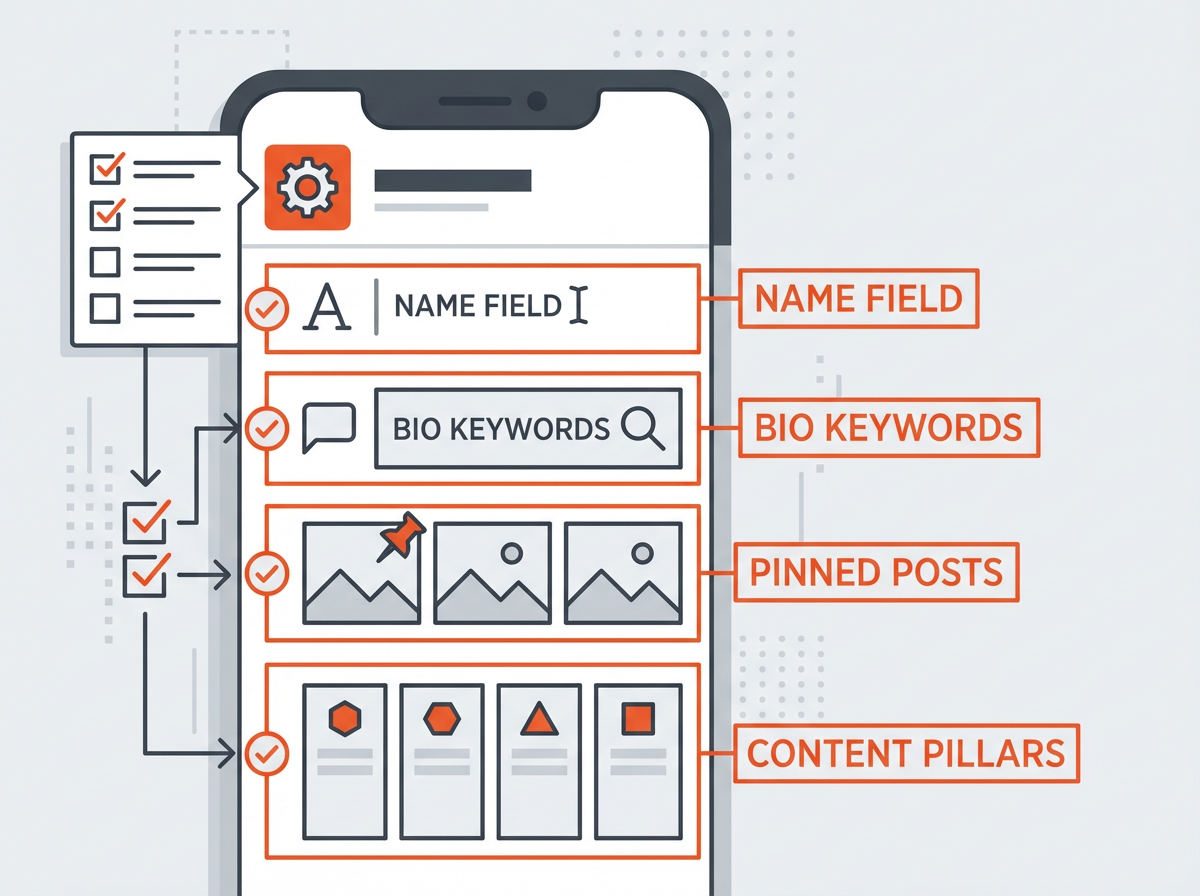
Tip 17: Use pinned posts to control first impressions
Pinned posts act like your storefront. When people discover you, they decide quickly whether to follow.
Action: Pin: (1) your best “start here” post, (2) your strongest proof/case study, (3) your most saved guide.
Tip 18: Encourage profile actions (they’re underrated)
Profile visits, website taps, and follows are strong indicators your content matched intent.
Action: Add a simple CTA: “If you want the full checklist, it’s in my bio” or “Follow for weekly [topic] breakdowns.”
Tip 19: Build “topic authority” with content pillars
Accounts that post consistently around a few themes are easier to categorize and recommend.
Action: Pick 3–5 pillars (e.g., “beginner tips,” “behind the scenes,” “case studies,” “tools,” “myths”) and rotate them.
Tip 20: Track the right metrics (and stop obsessing over likes)
Likes are easy to see, but they’re not always the best predictor of growth in 2026.
Action: Track per format:
- Reels: average watch time, completion rate, shares, follows per Reel
- Carousels: saves, shares, reach from Explore, time spent
- Stories: completion rate, replies, sticker taps, link clicks
Common myths about the Instagram algorithm in 2026
Let’s clear up the stuff that wastes time.
Myth: “Instagram is shadowbanning me”
Sometimes visibility drops due to content fatigue, weak hooks, inconsistent posting, or topic confusion. True enforcement can happen if content violates guidelines, but most “shadowban” claims are really performance issues.
What to do: Check Account Status, review recent posts for retention drops, and tighten topic consistency.
Myth: “Hashtags don’t matter at all”
Hashtags aren’t the growth engine they once were, but they still help with categorization and discovery in some niches.
What to do: Use a small set of highly relevant hashtags (think 5–12), not 30 random ones.
Myth: “You have to post every day to grow”
Frequency helps you learn faster, but quality and consistency matter more than daily posting.
What to do: Choose a schedule you can sustain (e.g., 3 Reels + 1 carousel per week) and improve week over week.
Instagram SEO in 2026: how to rank in Search and suggested content
If you’re not thinking about Instagram SEO, you’re leaving discovery on the table. The platform is increasingly keyword-aware, and users are searching with real intent.
Where to place keywords naturally
- Name field: Add a role keyword (e.g., “Nutrition Coach,” “Real Estate Agent NYC”)
- Bio: Who you help + outcome + proof
- Captions: Use your primary phrase early
- On-screen text: Clear topic labels
- Alt text: Descriptive and relevant
How to build authority for one topic
Instagram learns what you’re “about” by patterns. When you consistently post around a topic, your content is more likely to be recommended to people who engage with similar content.
Action: Create 10 posts around one subtopic (e.g., “Reels hooks for coaches”) before pivoting hard to something else.
What to post in 2026: format strategy that matches the algorithm
Different formats do different jobs. Here’s a simple strategy that aligns with how ranking works now.
Reels for reach
- Use for discovery and non-follower growth
- Prioritize hooks, retention, and shareability
- Keep topics tight and repeatable
Carousels for depth (and saves)
- Use for education, frameworks, and step-by-step content
- Great for building trust and getting saves
- Strong for converting profile visitors into followers
Stories for relationship and conversion
- Use for daily touchpoints, trust-building, and offers
- Drive DMs, link clicks, and warm engagement
- Great place to test content ideas fast
Lives and long-form video for authority
Live sessions and longer videos can deepen trust with your core audience.
Action: Go Live twice per month with a clear theme and repurpose the best moments into Reels.
How to test and adapt when the algorithm changes
Instagram updates constantly. The accounts that win aren’t the ones who guess right once—they’re the ones who test systematically.
Use a simple testing loop
- Pick one variable: hook style, Reel length, topic, editing pace, CTA
- Run 5 posts: keep everything else similar
- Review results: watch time, shares, saves, follows per reach
- Double down: turn the winner into a series
Benchmarks to watch (so you don’t get fooled by vanity metrics)
- Follows per 1,000 views (Reels): indicates content-to-audience fit
- Saves per reach (carousels): indicates practical value
- Shares per reach: indicates virality and identity resonance
- Story completion rate: indicates relationship strength
Conclusion: make the 2026 Instagram algorithm work for you
The most important thing to know about how the Instagram algorithm works in 2026 (20 actionable tips) is that it’s not rewarding hacks—it’s rewarding viewer satisfaction. If your content is easy to understand, tightly targeted, and genuinely helpful or entertaining, the algorithm becomes your distribution partner.
Your next move: pick 3 tips from this guide and implement them in your next 7 days of posts. Then review your watch time, saves, and shares—and iterate. If you want, tell me your niche and what you post most (Reels, carousels, or Stories), and I’ll suggest a simple 2-week content plan built around these ranking signals.