To remove your own eligible digital signature in Adobe Acrobat, right-click the signature and choose Clear Signature. If you added a drawn or image signature through Fill & Sign, use its delete control while the mark is still editable. Deleting a reusable signature saved in the app is a separate task.
Before you start, keep the original file. Work only on documents you’re authorized to change. If someone else has signed, the file is locked, or the agreement is already complete, ask the sender for an unsigned original or a new version everyone can review.
Important correction: Removing a signature does not make an edited PDF tamper-proof or preserve the removed digital signature’s verification. The earlier version of this guide blurred those distinctions. This guide explains the limits alongside the steps.
Key takeaways
- Identify the signature type before choosing a removal tool
- Correct your own editable mark before you finish signing and save the form
- Use Acrobat’s Clear Signature command only for your own eligible digital signature
- Keep the signed original and make agreed changes in a separate working version
- Check certificate information and permitted changes instead of judging a signature by its appearance
- For completed agreements, coordinate a new agreed version with the sender
Check what kind of signature your PDF contains
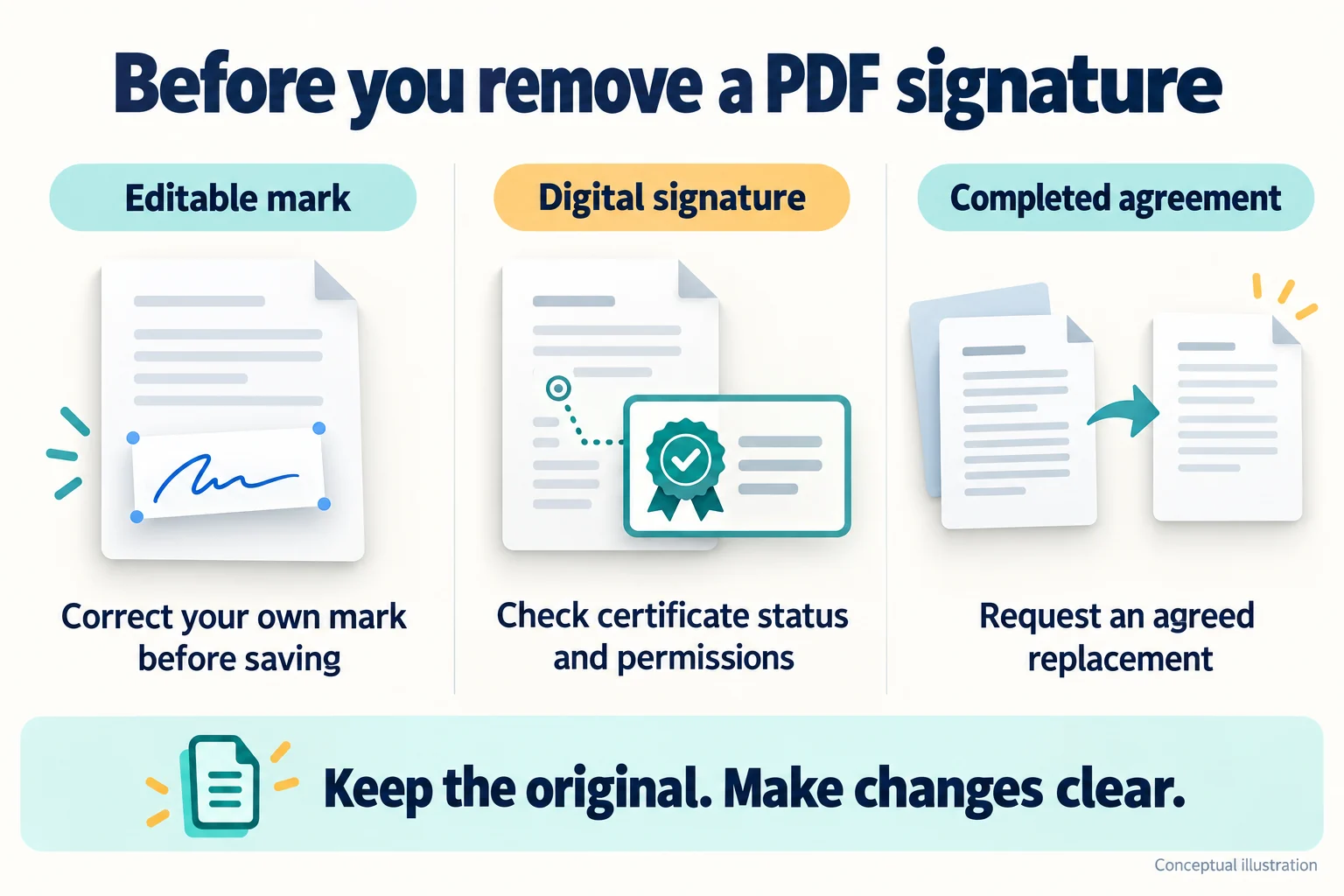
A handwritten-looking signature tells you very little about what’s underneath it. Start by answering two questions: did you simply place a signature mark, or did you sign using a digital ID? Then check whether you are still editing a draft or looking at a completed agreement.
Typed, drawn, and image signatures
Adobe’s e-sign tools let you type your name, draw it, or insert a signature image. Depending on the app and the stage of the workflow, the mark may still be selectable or may already be embedded in the saved PDF. Adobe describes these options in its e-signatures overview.
For example, a signature placed on the wrong line while you’re preparing your own draft is a placement mistake you can often fix before saving. A downloaded copy of an agreement that everyone has already signed needs a different approach, even if the signature looks like an ordinary image.
Certificate-based digital signatures
A digital signature uses a certificate-based digital ID and verification data connected to the signed document. Acrobat can validate signatures and track document changes. A certification signature can also define allowed later actions, such as filling fields or adding comments. See Adobe’s digital signatures overview.
Some certificate signatures are invisible. Others show a name, date, or handwritten-style appearance. You need the signature information in the PDF reader to understand the file’s status.
Saved signatures and completed agreements
A signature saved in an app is a reusable item you can choose for a future document. Deleting that saved item is separate from correcting a mark on a page. It also doesn’t undo a signing transaction or withdraw an agreement you’ve already sent.
If your question is really “How do I change what I agreed to?”, start with the sender or the person responsible for the agreement. A PDF editing command cannot answer that question for you.
How to clear your own digital signature in Adobe Acrobat
Adobe documents Clear Signature for a PDF where you’re the only signer. Treat this as an option for an eligible file, not a guarantee that every signed PDF can be reopened for editing.
- Keep the original signed PDF in a separate location before changing your working copy
- Open the working copy in Adobe Acrobat
- Confirm that the digital signature is yours and that no other person has signed
- For a visible signature, right-click it and choose Clear Signature, if that command is available
- Save the resulting working version with a clear new filename, review the changes, and arrange signing again where required
Adobe warns that choosing Lock document after signing can prevent further editing even by the signer. For a locked file or a document with other signers, its recommended route is an unsigned or source copy from the owner. Read Adobe’s signed-PDF permissions and limitations.
On a Mac, Control-click opens the signature menu described in Adobe’s Mac instructions. That shortcut does not change the ownership or locking limits.
Example: You signed your own draft, then spotted a wrong reference number before anyone else signed. Keep the signed file, check whether the clearing command is available, and prepare a clearly named revision. If you already sent the file to someone or completed a signing transaction, agree on the revision process first.
Don’t represent the edited working copy as the same signed original. If you send a revised version, make the change clear to the recipients and follow the review process used for that document.
How to remove an editable signature mark before saving
If you just placed your own signature in the wrong spot, fix it while the signing interface still lets you select it. The important detail is when you’re making the correction.
In Acrobat on the web
While placing a signature in Acrobat’s web Fill & Sign workflow, select the mark and use the delete control in its hover menu. You can then place your own signature where it belongs.
Adobe explicitly warns that once you save the form, the signature or initial you added can no longer be edited. These steps apply to the editable placement stage. See the current Acrobat web Fill & Sign instructions.
If the document contains confidential information, use your organization’s approved tools. Uploading it to a website shares the file with that service, so check that you have permission before using an online editor.
In Acrobat on iPhone or Android
During the editable stage in Acrobat mobile, tap your placed signature and choose Delete. Make your correction before the final save action. Adobe’s mobile guide says that saving flattens signatures and initials, so the resulting PDF cannot be unsigned through that workflow. In the current guide, Android uses a checkmark for the final save, while iOS uses Done after placement.
Example: You placed your signature beside the wrong field on your phone. Tap and delete that mark before the final save, then place it beside the correct field. Creating a signature and finishing the signed PDF are separate stages.
See Adobe’s mobile Fill & Sign guide for your platform. If you’ve already saved, return to your unsigned copy rather than assuming the same delete control will still work.
How to delete a saved signature in Acrobat or Preview
This is the right section if you want to replace an old reusable signature with a new one. Check that you’re changing the saved signature in the app, rather than trying to rewrite a document you’ve already signed.
Remove a saved signature in Acrobat
- Open a PDF in Acrobat and select E-Sign
- Find the current signature in the left pane
- Select the Remove your signature X
- If you want a replacement for future use, choose Add signature and create your own updated signature
Adobe documents this in Modify e-signatures. Its guidance also warns that signatures embedded in a signed form aren’t easily edited or removed. Deleting the reusable item isn’t a way to revise all your previously signed PDFs.
Example: You want to replace an untidy saved signature with a neater version for future forms. Remove the saved item and create a replacement. Your previously completed documents need to stay in their own revision process.
Remove a saved signature in Preview on Mac
- Open a file in Preview
- Show the Markup toolbar if it is hidden
- Click the Sign button
- Move the pointer over the saved signature and click its X
Apple says this deletes the saved signature from apps that use Markup on that Mac. With iCloud Drive enabled, the removal also applies to your other Macs using iCloud Drive. See Apple’s Preview signature guide.
Example: You no longer want an old signature available in Preview’s signing menu. Delete the saved item there. Don’t mistake its disappearance from that menu for removal from every PDF you previously signed.
Preview also works with PDF annotations, and whether an annotation remains editable depends on how the file was saved. Apple’s annotation guide explains that distinction. None of these instructions establishes that Preview can clear a certificate signature or preserve its validation after editing.
What to do if Clear Signature is missing or the PDF is locked
Pause and establish how the file was created. A missing command isn’t a reason to start trying conversion tools until one makes the lock disappear.
- You used Fill & Sign: Go back to the unsigned version if the saved mark is no longer editable
- You received someone else’s signed PDF: Ask the sender for the appropriate working copy
- Several people signed: Coordinate the revision with the document owner and the signers
- The file is explicitly locked: Request a new unsigned version instead of trying to bypass the restriction
- You only wanted to replace a stored signature: Use the app’s saved-signature controls described above
A useful request to the sender is: “Could you send the unsigned source version? I need to correct the delivery address. I’ll send the revised version back for review.” Describe the actual change you need rather than asking for an unrestricted copy without context.
Example: A supplier has already countersigned an agreement, but the delivery address is wrong. Ask the person managing the document for the approved correction process and a new working version. Removing the supplier’s mark would not establish their approval of your correction.
For a completed agreement, ask the sender which correction or replacement process applies. Keep the signed record available. Don’t remove another person’s signature, copy it onto a revised agreement, or conceal a change behind an unchanged-looking page.
Check signature validity and permitted changes
For a certificate-signed PDF, use Acrobat’s verification controls before drawing conclusions:
- Open the PDF and select Signatures from the right panel
- In the panel’s Options, choose Validate Signatures
- Read the validation details
- Open Signature Properties, then Show Signer’s certificate, when you need certificate information
These steps come from Adobe’s validation guide. Check the actual message. Certificate trust and timestamp information can matter as well as the document’s contents.
There is an important nuance here: a certified PDF may allow specified later actions. Adobe’s certification documentation explains how permitted changes are set. An allowed form entry or additional signing step is different from replacing the agreed text. Follow the permissions recorded for that document.

Clearing a digital signature removes that signature from the working file. Changes outside the allowed workflow can affect validation. A page that still looks signed gives you no assurance that the edited file has the same verified status as the original.
Should you use an online PDF signature remover?
Start with the app that created your signature or the sender who supplied the document. A tool advertised as a “PDF signature remover” may be talking about editable images, annotations, form fields, or a conversion process. Those are different tasks.
Before uploading a file, check:
- Does the tool describe the signature type it supports?
- Are you authorized to edit this document and share it with the service?
- Does your workplace require an approved tool for these files?
- Can you keep the original and clearly identify the revised output?
Skip any workflow that promises to change a signed agreement while hiding the changes or keeping the old approval intact. Recreating a page’s appearance doesn’t establish that its contents were approved.
If you’re preparing an authorized public copy and only need to protect a visible signature, treat that as a separate redaction task. Keep the original privately and label the disclosure copy. Use a redaction tool that removes the content, apply the redactions, and check for hidden information before sharing. Adobe documents this process in its image-redaction guide. An edited disclosure copy should not be presented as an unchanged, signature-validated original.
Example: You’re allowed to publish a copy of a document, but the handwritten signature must stay private. Follow a separate PDF redaction and review workflow. A white rectangle over the signature isn’t evidence that the underlying content has been removed.
You can also search the PDF for names and repeated text during your review. Search results are only one check: a signature image, a scan, or hidden information may need separate inspection.
Frequently asked questions
Can I remove a signature from a PDF for free?
Some corrections, such as deleting a saved signature in Preview, don’t require buying another editor. Whether a placed signature can be removed depends on its type and whether the document is still editable. Paying for a remover doesn’t change the authorization you need.
Does removing a signature cancel an agreement?
Don’t assume that deleting a mark, a saved signature, or a file cancels anything. If your aim is to withdraw or change an agreement, contact the other party or the person managing it. For legal consequences, ask a qualified adviser familiar with the situation.
Can I remove someone else’s signature?
This guide doesn’t cover altering another person’s signed agreement. Ask for an unsigned original or a new agreed version, and have the responsible people review and sign it through the appropriate process.
Can I remove the signature panel or an empty signature box?
First establish what you’re seeing. A viewer panel, an empty form field, a reusable signature, and a completed signature are different things. Hiding a panel only changes your view. If you’re designing a blank form you own, edit its source template instead of using a signed agreement as the starting point.
Can I keep a digital signature valid after editing?
That depends on the document’s signature permissions and the change. Check the permitted actions and validation details rather than assuming any edit is safe. For changes to agreed content, prepare a new version for review and signing.
Final thoughts
If the correct control isn’t available, stop with the original intact. Tell the sender what needs changing and ask for the right working copy. A clear revision history is more useful than an edited page that merely looks right.