
To fix duplicate title tags in WordPress, first check what is duplicated. Two different URLs can have the same title text, or one page can output two HTML <title> elements. Those problems need different fixes.
I’d start with one affected URL and the exact warning from your audit tool. That gives you a much safer starting point than changing your permalink structure, switching themes, or installing another SEO plugin.
Below, I’ll show you how to separate the cases, find the setting or output responsible, and check the result without making unnecessary site-wide changes.
Key takeaways
- Read the warning carefully. Duplicate titles across URLs and multiple title elements on one URL are separate issues.
- Check the affected pages before changing settings. Record their titles, content, indexability and canonical URLs.
- Use the SEO tool you already have. A page-level title edit or a corrected template may be enough.
- Protect the live site. Back up first and investigate theme or plugin conflicts on staging.
- Check pagination separately. Google allows repeated titles within a genuine paginated sequence; a page-number suffix is optional.
- Verify the output. A saved SEO field or a cleaner audit score alone does not establish that the right HTML reaches visitors.
What do duplicate title tags actually mean?
Different URLs have the same title text
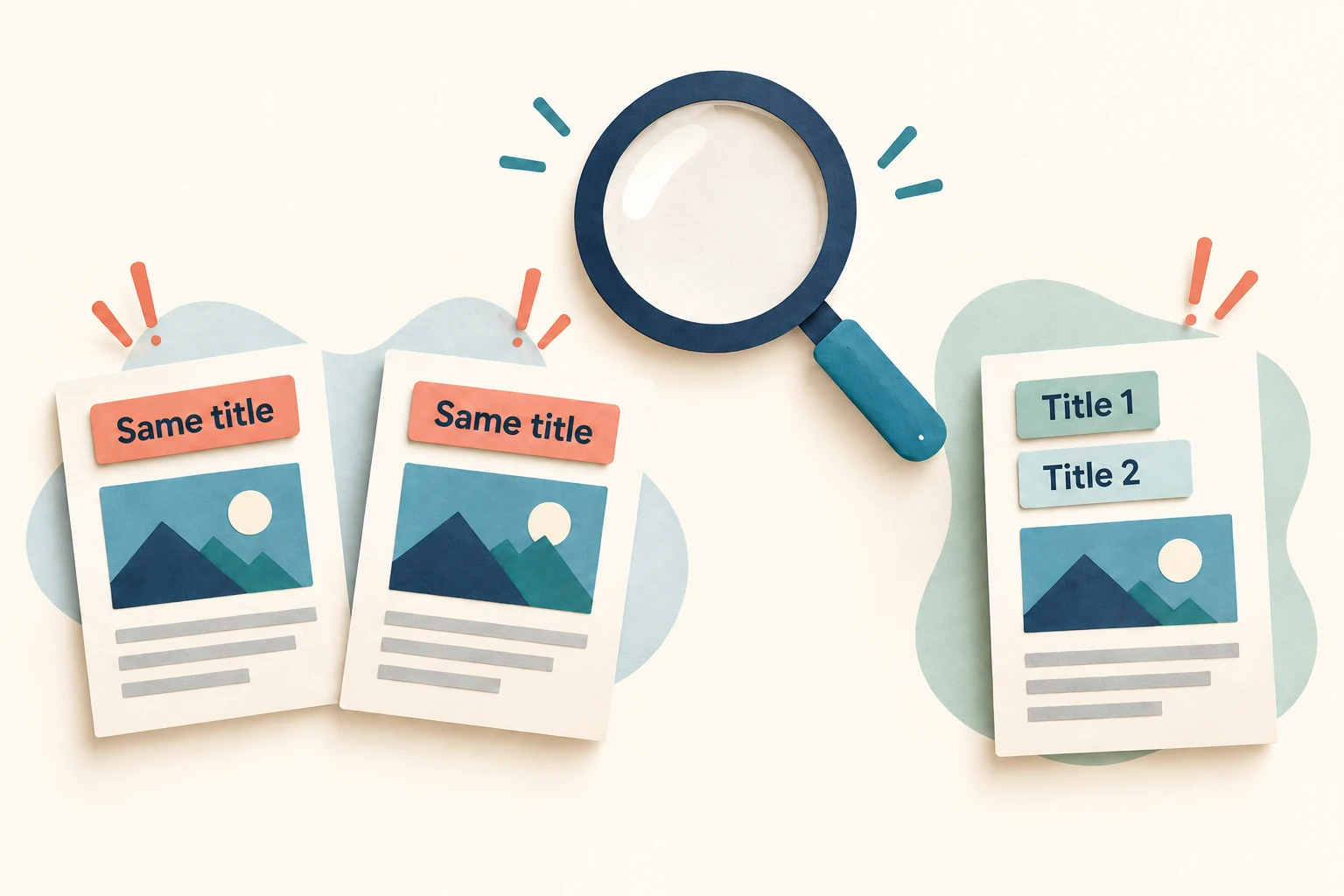
Imagine that your WordPress backup tutorial and your WordPress security tutorial both use “WordPress Guide | Your Site” as their SEO title. Each page might contain exactly one title element. The duplication is between the pages.
If the articles answer different questions, give each one a title that describes its own content. If both URLs serve essentially the same article, investigate the duplicate URLs before spending time rewriting titles.
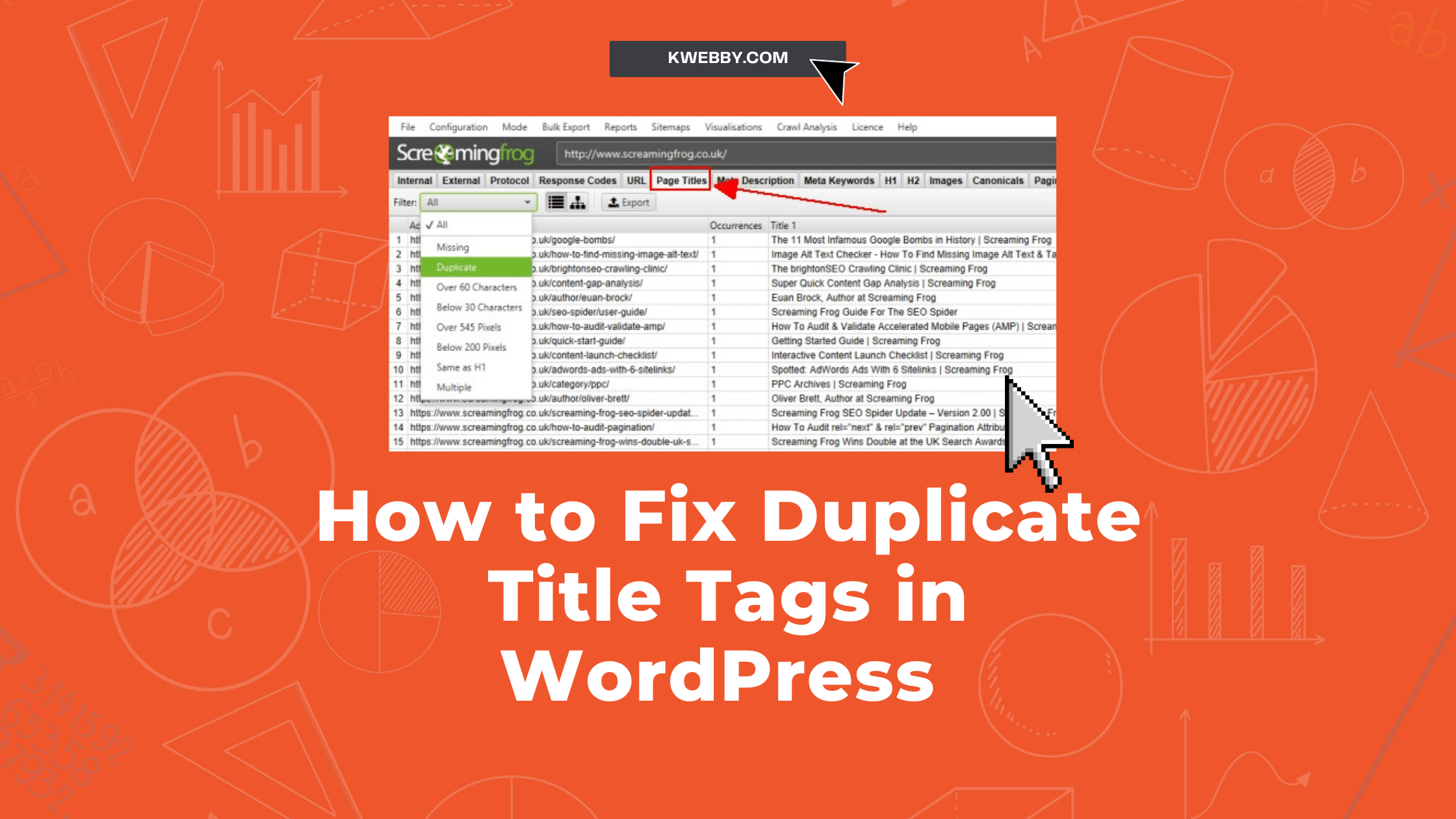
Screaming Frog calls the first audit condition Page Titles: Duplicate: multiple URLs sharing a page title.
One page contains multiple HTML title elements
Here, one HTML document contains two or more document-title elements. For example, an older theme might output a hard-coded title while another component also generates one.
Changing the wording inside your SEO plugin will not necessarily remove that extra output. You need to identify the component producing it.
Screaming Frog documents this separately as Page Titles: Multiple.
A heading or social title is being mistaken for an extra title
Your visible article heading, usually an H1, serves a different purpose from the document title. Finding both does not establish that you have two HTML title elements.
Likewise, og:title is social-sharing metadata. It can repeat the SEO title without being a second <title> element. Our guide to social media meta tags explains where those fields fit.
Also check the surrounding markup. A title inside an SVG icon, an escaped code example, or text inside a script is not automatically an additional HTML document title. Count the actual elements in context.
How to find the cause before you edit WordPress
You can do the initial diagnosis without changing WordPress at all. I’d keep a short record of the affected URLs so you can repeat exactly the same checks afterward.
Read the audit label and group the affected URLs
In Screaming Frog, review the Page Titles tab and its Duplicate and Multiple filters separately. Export the affected URLs rather than treating the total issue count as a diagnosis.
Group the results into posts, pages, categories, tags, products and paginated archives. A repeated pattern across one page type suggests a shared template deserves inspection; a single pair of posts may only need individual edits.
For example, ten category archives titled only “Blog” point you toward the archive title template. Two unrelated service pages both titled “Services” point you toward their saved SEO titles.
Start with the indexable pages that matter to your business. A tracking-parameter copy and a primary product page can appear in the same report while needing very different treatment.
Inspect the document title on one affected page
- Open an affected public URL while logged out of WordPress, or in a private browser window.
- Use your browser’s View Page Source option and search for
<title. - Look at the surrounding HTML and record the complete document-title text in the
<head>section. - Check whether you have one actual document-title element or more than one. Ignore matching text inside examples or unrelated markup.
- Repeat on a second URL from the same audit group and on one unaffected page.
If the original source has one title but a JavaScript-rendered crawl reports more, inspect the rendered document in the browser’s developer tools as well. Ask your developer to compare the original HTML and the rendered head before changing the PHP theme files.
For me, the useful question here is simple: where does the second title first appear? That separates a server-generated conflict from a later rendering problem.
Record content, canonicals and indexability
For each sample URL, note its final destination after redirects, title text, number of title elements, canonical target and any noindex instruction. Add a plain-English description of what the page contains.
Compare the actual content on the URLs. Matching titles do not prove that two pages are duplicates, and different titles do not make copied content unique.
Keep the audit date and crawl settings with your notes. An old crawl can continue to show a problem that has already been corrected.
Make a backup and choose a safe place to test
Before changing templates, plugins or code, take a complete backup of the files and database and confirm how you would restore it. If you need the basics, see our WordPress backup guide.
Copy the existing title settings into your notes too. That makes a targeted rollback easier than trying to remember which variables were there before.
Use a staging copy for plugin deactivation, theme switching and code changes. Make sure the copy is protected from public indexing and that test activity cannot send real customer emails or trigger live orders.
Yoast’s conflict-check documentation also describes a troubleshooting mode that changes the environment for your logged-in session. External crawlers may still see the normal public site, so their results will not necessarily reflect that session.
If you cannot isolate the test safely, send the affected URLs and source findings to your developer or plugin support. Randomly deactivating production plugins can disrupt features beyond page titles.
Fix identical titles on pages with different content
When the content is genuinely different, make that difference obvious in the SEO titles. Keep the existing URLs unless there is a separate, justified reason to change them.
For a hypothetical pair of tutorials, “Back Up WordPress Before an Update | Your Site” and “Restore WordPress From a Backup | Your Site” tell readers which task each page covers.
Google’s title-link guidance recommends descriptive, concise titles and warns against repetitive boilerplate and keyword stuffing. Adding random numbers or extra keywords just to silence a warning misses the point.
Edit an individual title in Rank Math
Open the affected post or page. In the block editor, open the Rank Math SEO panel, choose Edit Snippet and review the Title field. In the classic editor, look for the Rank Math meta box below the content.
Enter a title that fits that page, save the post, and inspect the public output. Rank Math documents this workflow in its meta-title guide.
Check that you changed the SEO title you intended. You do not need to alter the permalink merely because you edited the title.
Repair the affected Rank Math title template
If a whole page type has the same generic title, open Rank Math SEO → Titles & Meta and select the relevant section, such as Posts, Pages or the affected taxonomy.
Review the title template for that section only. Rank Math’s Titles & Meta documentation distinguishes these shared defaults from page-specific settings.
For ordinary posts, a starting example is %title% %sep% %sitename%. For taxonomy archives, %term% supplies the current term name. Pick variables that exist for the type of page you are editing.
These examples use Rank Math’s syntax. Its variable reference explains the available values. A template cannot distinguish two posts if both underlying post titles are also identical.
After saving, check one normal post, one post with a custom SEO title and the affected archive. That catches differences between inherited templates and individual overrides.
Edit titles and templates in Yoast SEO
For a single post or page, open its Yoast SEO panel or meta box and edit the SEO title in Search appearance. Save the post and check the public page.
For repeated template problems, go to Yoast SEO → Settings. Choose Content types for posts or pages, or Categories & tags for the relevant taxonomy. Edit the SEO title under Search appearance, then save the change.
Yoast’s current template instructions also identify archive and special-page settings. Older tutorials may refer to a separate Search Appearance submenu.
A post template could use %%title%% %%sep%% %%sitename%%. For a taxonomy, choose the appropriate term variable instead. Yoast’s variable list uses doubled percent signs, unlike Rank Math.
You do not need to buy Premium just to use title-template variables. Yoast lists that feature as available in its free plugin.
Once the duplication is resolved, our guide to writing SEO titles and descriptions can help you refine the wording.
Check pagination before treating it as an error
A category archive and its second page can legitimately belong to one paginated sequence. Google explicitly allows the same titles and descriptions across that sequence, even though a crawler may flag them as duplicates.
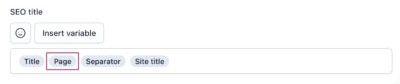
You can add a page number for clarity. In Yoast, the Page number variable is %%page%%; in Rank Math, %page% adds pagination context on page 2 and beyond.
Use the appropriate archive or post template, then check page 1 and page 2. Avoid adding the suffix twice if another setting already supplies it.
The more consequential check is the URL and canonical setup. Google’s pagination guidance says to give each page a distinct URL and its own canonical. Do not canonicalize every page to page 1 when those pages contain different items.
I would review a real archive sequence before deciding that a repeated title needs any change. The audit warning is a reason to investigate, not a reason to hide useful pages from search.
Fix duplicate URLs when the content is the same
Suppose a clean article URL and a version with a tracking parameter both show the same article. Giving the parameter version a new title would leave the underlying duplication in place.
Choose the preferred URL based on the content and how the site is meant to work. Google’s canonicalization documentation explains how redirects, canonical annotations and sitemap inclusion can communicate that preference.
- A retired duplicate URL: consider a permanent redirect to its genuinely equivalent replacement, after checking existing links and how visitors use the page.
- A duplicate that must remain accessible: a canonical annotation may identify the preferred equivalent page.
- A useful page with different content: keep its identity and improve its title instead of pointing it at an unrelated page.
Google’s canonicalization overview makes clear that the final selection belongs to Google. Your preferred URL is a signal, not a guaranteed outcome. Keep internal links, redirects and sitemap entries consistent with your preferred version.
If a redirect is appropriate, our WordPress redirect guide explains the available approaches. First make a URL-by-URL plan; changing the entire permalink structure is far too broad a response to a title warning.
Noindex is a separate decision to keep a page out of search. Do not noindex every tag, category or author archive simply because it appears in a duplicate-title report. Some archives are useful landing pages.
Google also advises against using noindex as a method of choosing a canonical within one site. Decide what should be indexed based on the page’s purpose before changing indexing instructions.
Fix multiple title elements from a theme or plugin conflict
If your source check confirmed multiple document titles, work on the generator responsible. Rewriting the same SEO field repeatedly will not tell you which component added the extra element.
On staging, record the active theme, child theme, SEO plugin and any custom header or code-snippet tools. Check their documented title-output settings before disabling anything.
Then change one suspected component at a time and revisit the same sample URL. Keep a record of when the second title disappears and whether it returns when you restore that component. That gives your developer or vendor a reproducible case.
Two SEO-related plugins are not automatically incompatible. An official add-on can be designed to work with its parent plugin. The question is whether two independent components are both generating the document title.
Understand WordPress title support before editing theme code
WordPress documents add_theme_support( 'title-tag' ) as the feature that lets themes and plugins manage the document title, in place of the older wp_title() approach. See the official theme-support reference.
An older theme that retains a manual title element alongside a newer title-generation path is a case for a developer to inspect. The correct change depends on the theme and how its head markup is assembled.
I would not paste a universal removal snippet into a live site or delete a random title line from a parent theme. A wrong change can remove the remaining valid title, and a parent-theme update can overwrite direct edits. WordPress explains the safer customization model in its child-theme handbook.
Do not remove wp_head() to make the extra title disappear. The WordPress hook documentation shows that it is used for other front-end scripts and metadata too.
Ask the developer to keep one supported title-generation path, preserve the other head output, and test the change in a maintainable customization or vendor fix. Check the homepage, a post, a page, an archive and pagination before deploying it.
Verify the fix in the source and your next crawl
After the approved change is live, clear the relevant page cache and CDN cache using your existing setup, then reopen the affected pages while logged out. A cached response can hide whether the new output is correct.
- Inspect the HTML again. Confirm one intended document-title element on every previously affected sample.
- Compare the title text. Distinct content should have appropriately distinct titles; a genuine pagination exception can be documented.
- Check the rest of the head. Make sure canonical and robots instructions still match your intended indexing setup.
- Repeat the crawl. Use the same scope and settings, then compare the affected URL groups rather than only the overall score.
- Check unaffected page types. A fix for category archives should not erase custom product or homepage titles.
If you use Search Console, inspect important URLs to review their indexed canonical information. The official URL Inspection documentation distinguishes the indexed result from the live test: the live test cannot predict Google’s canonical selection.
Search results may take time to reflect a change, and Google can generate a title link using other page signals. A different search-result title does not by itself prove that the HTML repair failed.
Keep a note of the change date and compare relevant queries and pages over a meaningful period. Better technical output is something you can verify immediately; a particular ranking or traffic improvement is not guaranteed.
Frequently asked questions
Can I fix duplicate title tags without an SEO plugin?
Yes, depending on the cause. If your theme builds document titles from post titles, correcting those inputs may resolve repeated wording. If the theme outputs multiple title elements, a developer needs to correct that output. Installing another plugin is not a required first step.
Should I change my permalinks to fix duplicate titles?
No blanket permalink change is needed. Start with the title text or title-generation conflict. If you separately discover duplicate URLs, plan a targeted canonical or redirect change and check its consequences for existing links.
Does a duplicate-title warning mean Google has penalized my site?
The warning alone does not establish a Google penalty. It reports a condition found by the audit. Investigate the affected content and HTML, and keep any actual Search Console manual-action notice separate from a crawler’s title warning.
Why do duplicate titles return after I change the template?
Check individual SEO-title overrides, cached output and whether the template matches the affected content type. If two components generate titles, a text-template change may leave the extra element intact. Repeat the source check on the exact URL that was flagged.
Does every paginated page need a unique title?
Google allows shared titles within a genuine paginated sequence. Page numbers can help readers distinguish the pages, but treat the sequence’s URLs, internal links and canonical setup as separate checks.
Final thoughts
The first useful fix is knowing which problem you have. Check the affected URL, identify the source of the title, and choose the smallest change that addresses it.
For separate pages, that may be a clearer title or a better template. For duplicate content, it may be a URL-consolidation decision. For two document-title elements, it means correcting the competing output safely.
Keep your original URLs unless there is a genuine reason to change them, and finish by checking the HTML that visitors actually receive.