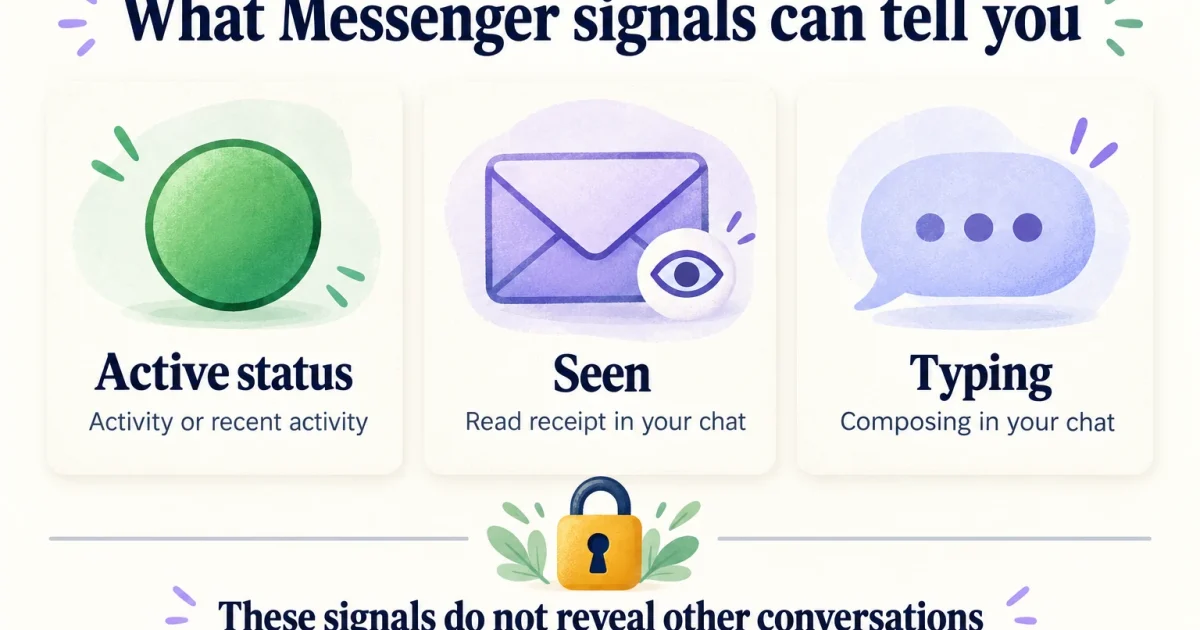

You can’t tell whether someone is chatting with another person on Facebook Messenger from their green dot or “Active now” label. Those indicators show activity information. They don’t reveal who someone is messaging, whether a conversation is happening, or why they haven’t replied to you.
You can learn more about your own conversation from delivery notices, read receipts, and typing indicators. I’ll explain what each signal tells you, where its limits are, and which privacy choices are worth reviewing on your account.
Key takeaways
- A green dot or “Active now” label doesn’t prove someone is having a conversation.
- Presence information doesn’t identify another conversation or the person involved in it.
- Sent, delivered, and seen describe different stages of a message in your conversation.
- A typing indicator refers to the conversation where you see it. It doesn’t expose other chats.
- Missing activity information or read receipts doesn’t prove someone is ignoring you, hiding a conversation, or has blocked you.
Does “Active now” on Messenger mean they are talking to someone?
No. The status doesn’t tell you whether someone is sending messages. It also doesn’t identify another person they might be talking to.
Meta describes Active Status as a way to let people know when you’re active, with an option to turn it off. That makes it useful when deciding whether to send a normal message. It gives you much less information than a conversation history would.
Suppose you send “Are we still meeting at six?” and the other person appears active. Your question is still unanswered. The status alone doesn’t tell you whether they noticed it, are ready to make plans, or have time to respond.
I wouldn’t turn that one indicator into a story about what they’re doing. If you need a decision, ask for the decision: “Please let me know by five so I can plan my trip.” That addresses the practical problem without trying to interpret their online activity.
What the green dot and last active time actually tell you
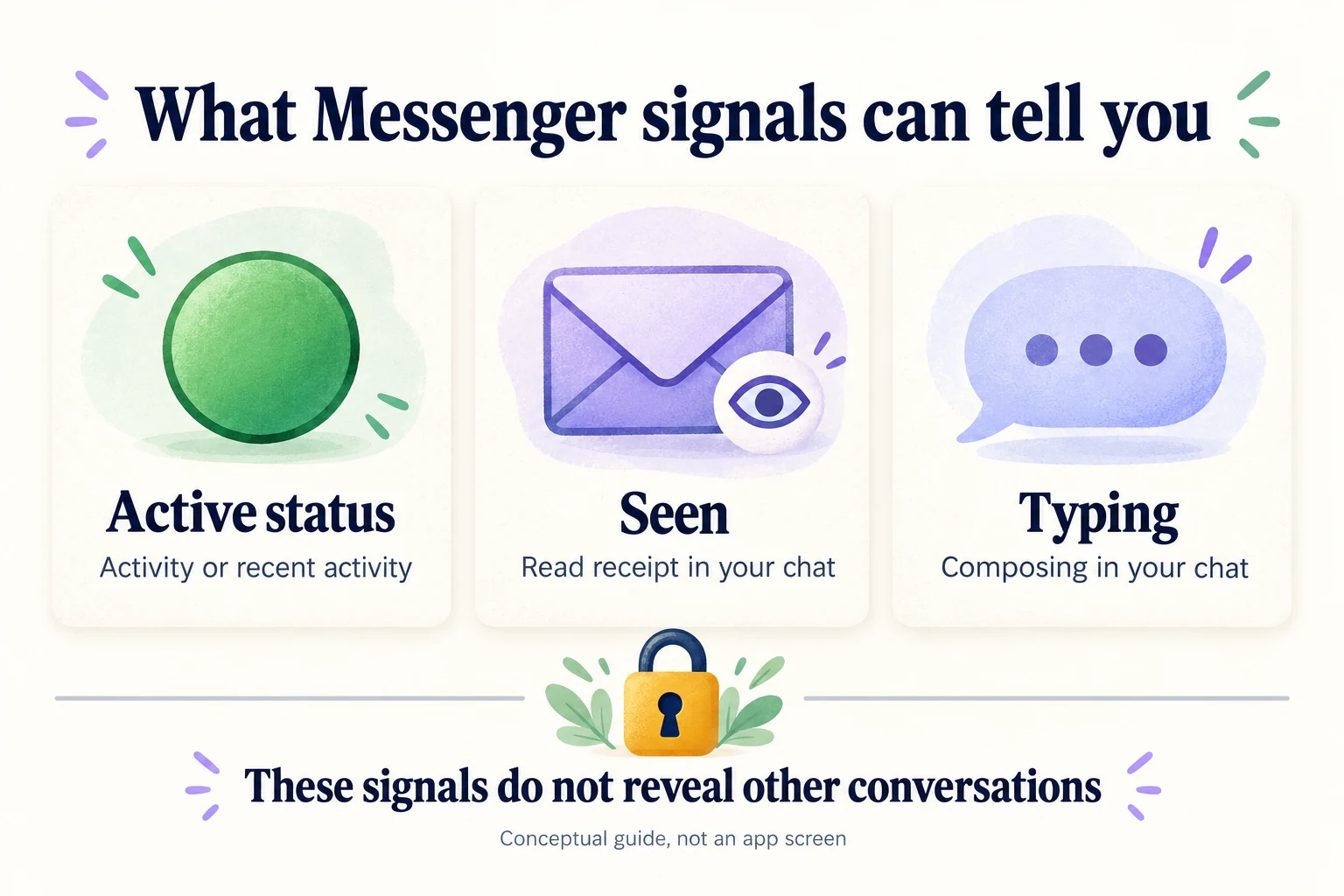
An activity indicator gives you limited presence information. Depending on what is visible in your conversation, you may see an activity label or information about recent activity.
Read the label as the presence information Messenger is choosing to show you. It doesn’t describe a conversation, identify another participant, or tell you what is on someone’s screen.

A recent-activity timestamp also isn’t a conversation timer. “Active 10 minutes ago,” for example, doesn’t tell you that a chat ended exactly ten minutes earlier or how long it lasted.
I wouldn’t use this information as a minute-by-minute account of another person’s actions. A timestamp doesn’t explain what they were doing before or after the time shown, and it doesn’t give you their messaging history.
Can you tell if two people are talking on Messenger?
No. Two green dots, similar last-active times, or people appearing online together do not establish that they are messaging each other.
There are many reasons two people could use an app at the same time. Matching their activity doesn’t give you access to a shared conversation or identify a relationship between them.
The same limit applies if you wonder whether someone is talking to somebody else while replying to you. Messenger’s indicators in your chat don’t provide an overview of their other conversations.
How to check the information visible in your own Messenger chat
Keep the check within your account and the conversation you already share. You don’t need another person’s phone, password, search history, or account access.
- Open your existing conversation. Look at any activity information Messenger makes visible to you. Don’t assume an old screenshot matches the version on your device.
- Check your own message’s status. Look for a delivery or read indication associated with a message you’ve already sent. Don’t confuse this with the contact’s general activity status.
- Notice a typing indicator if one appears. It is a cue about composing a message in that conversation.
- Ask directly when you need an answer. “Is now a good time?” is clearer than sending repeated test messages to watch the indicators change.
If you see no indicator, you have no extra activity information to interpret. It isn’t a reason to access someone else’s account or install a tracking tool.
If you cannot find the conversation itself, that is a separate problem. Our guide to missing and deleted Messenger messages explains the recovery limits and checks you can make within your own account.
Sent, delivered, and seen mean different things
These labels describe the progress of your message. They shouldn’t be used interchangeably.
- Sending: Messenger is still working on sending the message.
- Sent: The message has been sent. That alone doesn’t establish that the recipient has seen it.
- Delivered: Messenger reports delivery. This is separate from reading the message.
- Seen or a read receipt: Messenger reports that the message has been seen in that conversation.
Start with any status text that your version displays. If a symbol appears without an explanation, don’t assume its color or shape means the message was read. A delivery confirmation and a read receipt answer different questions.
Meta’s Messenger encryption overview discusses delivery receipts from recipient devices. Delivery is a technical stage in transporting a message; it doesn’t tell you whether the recipient has chosen to answer.
A delivery indicator doesn’t establish that someone is holding their phone or watching the conversation. A read receipt doesn’t explain their thoughts, whether they understood the whole message, or when they’ll reply.
Why a missing read receipt does not prove the message is unread
Messenger includes a read-receipt control. Meta’s announcement says it “allows you to decide if you want others to see when you have read their messages.”
That means the absence of “Seen” cannot settle whether a person has read your message. Don’t use a missing receipt as proof that they’ve avoided it, and don’t treat it as proof of another chat.
It helps to separate what you can see from what you want to know. “No read receipt is visible” is an observation. “They saw it and chose to ignore me” is an interpretation that the missing receipt cannot establish.
What a typing indicator means in your conversation
A typing indicator is a composing cue in the conversation where it appears. Meta describes typing indicators in one-to-one and group chats as a way to see when others are typing.
If you see one in your conversation, it relates to that conversation. It doesn’t let you watch someone typing in a separate private chat.
It also doesn’t guarantee a message will arrive. A person can begin writing, revise what they want to say, or stop before sending anything. An actual reply tells you what they chose to communicate.
For me, the useful distinction is simple: typing is a temporary cue, while a sent reply is something you can read and respond to. There’s no need to interpret a disappearing typing indicator as rejection or secrecy.
Why you might not see someone’s Active Status
Activity information is affected by privacy choices. A missing dot doesn’t give you a diagnosis of the other person’s account.
Meta confirms that people can switch Active Status off. Someone choosing not to share activity is enough to show why an absent indicator cannot prove that they have stopped using the service.
Start with the settings and explanations available in your own account. If something is missing or looks different from an older guide, don’t jump to conclusions about the other person’s account or intentions.
Even after checking your settings, don’t read missing activity as proof of blocking, being offline, or avoiding you. You may simply have no visible presence information. Waiting for a reply or asking about availability is more useful than repeatedly refreshing the contact list.
How to manage your own Messenger privacy
If the activity indicators make you feel pressured to answer immediately, review what your account shares.
Review your Active Status setting
Meta provides an option to turn Active Status off. If you want to change it, use the controls and help available in your own Messenger account, and read the explanation shown before confirming your choice.
Menu placement can change. Use the labels in your installed version rather than assuming an old screenshot’s hamburger menu or profile-picture location still matches your phone.
Review your read-receipt setting
Meta also provides a read-receipt control so people can decide whether others see when they have read a message. Review the control and its explanation in your account if you want to change that choice.
This is a separate choice from sharing your activity status. Turning off one signal shouldn’t be treated as a promise that every other signal is hidden.
Keep your account access private
I wouldn’t enter a password into a website that promises to reveal somebody else’s Messenger conversations or hand over account access for an “activity report.” A claim in an advertisement isn’t evidence that a service can provide that information safely or accurately.
Use settings inside your own account. You don’t need a surveillance app to understand Messenger’s status indicators, and someone else’s unlocked device isn’t an invitation to inspect their private messages.
The same care applies to claims about hidden accounts. Our guide to what you can actually check about a possible second Facebook account separates visible evidence from assumptions.
Does end-to-end encryption change what you can see?
Encryption protects message content. It doesn’t turn Active Status into a way to discover someone else’s conversation partner.
Older guides often refer to “Secret Conversations” as a separate feature. Meta began introducing default end-to-end encryption for personal Messenger conversations in December 2023. Check the information inside a particular chat for its encryption status rather than assuming every type of conversation works identically.
Another common mistake is saying encrypted messages are never stored on Meta’s servers. Meta’s security engineering explanation describes encrypted server-side message storage with keys under the user’s control. Storage and access to readable content are different questions.
For your original question, the practical result stays the same: activity indicators, read receipts, and typing cues don’t expose someone else’s private conversations.
Frequently asked questions
Does a green dot mean someone is chatting with another person?
No. It is an activity indicator. It cannot confirm a conversation or identify a conversation partner.
Can you tell whether someone is on Facebook or Messenger?
An activity indicator doesn’t give you a view of someone’s screen or explain what they are doing. I wouldn’t use that signal alone to decide whether they are reading Facebook posts, using a conversation, or preparing a reply.
Does delivered on Messenger mean the person is online?
Delivered reports message delivery. It doesn’t establish that someone is actively looking at Messenger, reading your message, or available to reply.
Does seen mean someone is still in your chat?
No. A read receipt concerns the message being seen. It isn’t a live indicator that the person is still reading the conversation.
Can you find out who someone is messaging with an app?
Messenger’s visible activity indicators don’t provide that information. I wouldn’t rely on third-party claims that promise to reveal it or give those services access to an account.
Why is someone active but not replying to me?
The indicator doesn’t explain why. A person may be unavailable for a conversation even when activity is visible. If you need an answer, send a clear question and say when you need a response.
Final thoughts
You can use Messenger’s indicators to understand the limited information shared with you: presence, message delivery, a read receipt, or typing in your conversation.
You can’t use them to identify somebody else’s private conversations. I’d keep that boundary in mind, check my own settings when something looks inconsistent, and ask directly when the answer actually matters.