

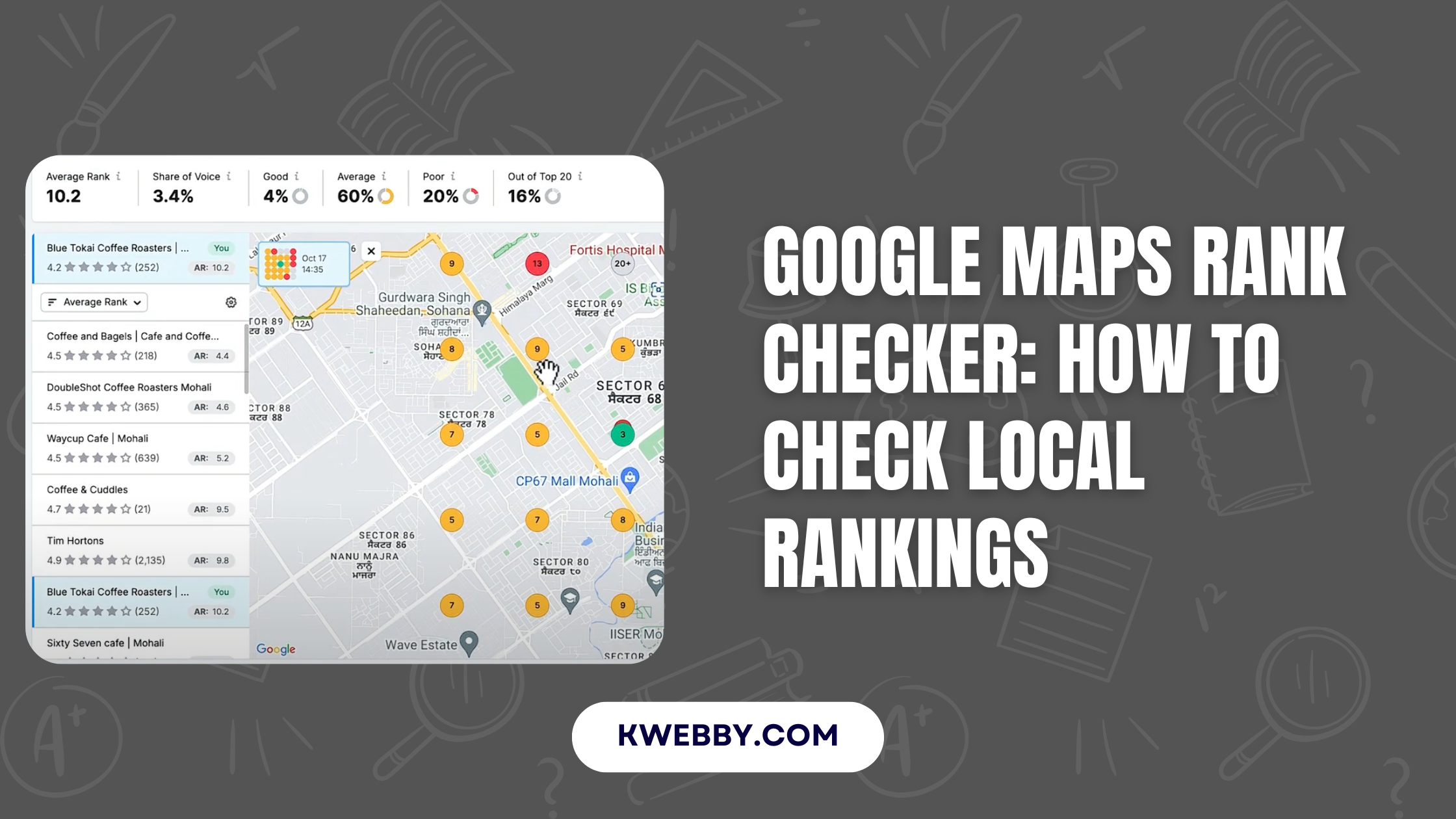

A Google Maps rank checker shows where a business listing appears for a particular keyword from a particular location. That last part matters. Your shop can appear near the top for someone nearby and much lower for someone searching across town.
For a quick check, I’d start with a free localized search or a limited free grid scan. For ongoing Google Maps rank tracking, choose a tool that saves the same keywords, map points and scan schedule so you can compare results fairly.
This guide explains the free limits, paid options and measurement settings worth checking before you spend money. The product details below were checked against vendor documentation on October 5, 2026. We haven’t run a comparative accuracy test or a campaign for your business, and the examples are illustrative.
Key takeaways
- Need one localized results check? BrightLocal’s free Local Search Results Checker is a straightforward starting point. Choose Google Maps rather than ordinary web results.
- Need a small free map grid? Compare Semrush’s restricted free Map Rank Tracker plan with GTrack’s free credits. Their limits and scheduling access differ.
- Already using Localo? Its free checker is useful for a snapshot. Check the current trial and subscription terms before expecting ongoing monitoring.
- Need repeated reports for clients or several locations? Work out your scan volume first, then compare credit-based tools with location-based plans.
The right choice is the smallest plan that answers your actual question. Paying for more pins won’t make the business rank higher by itself.
What a Google Maps rank checker measures
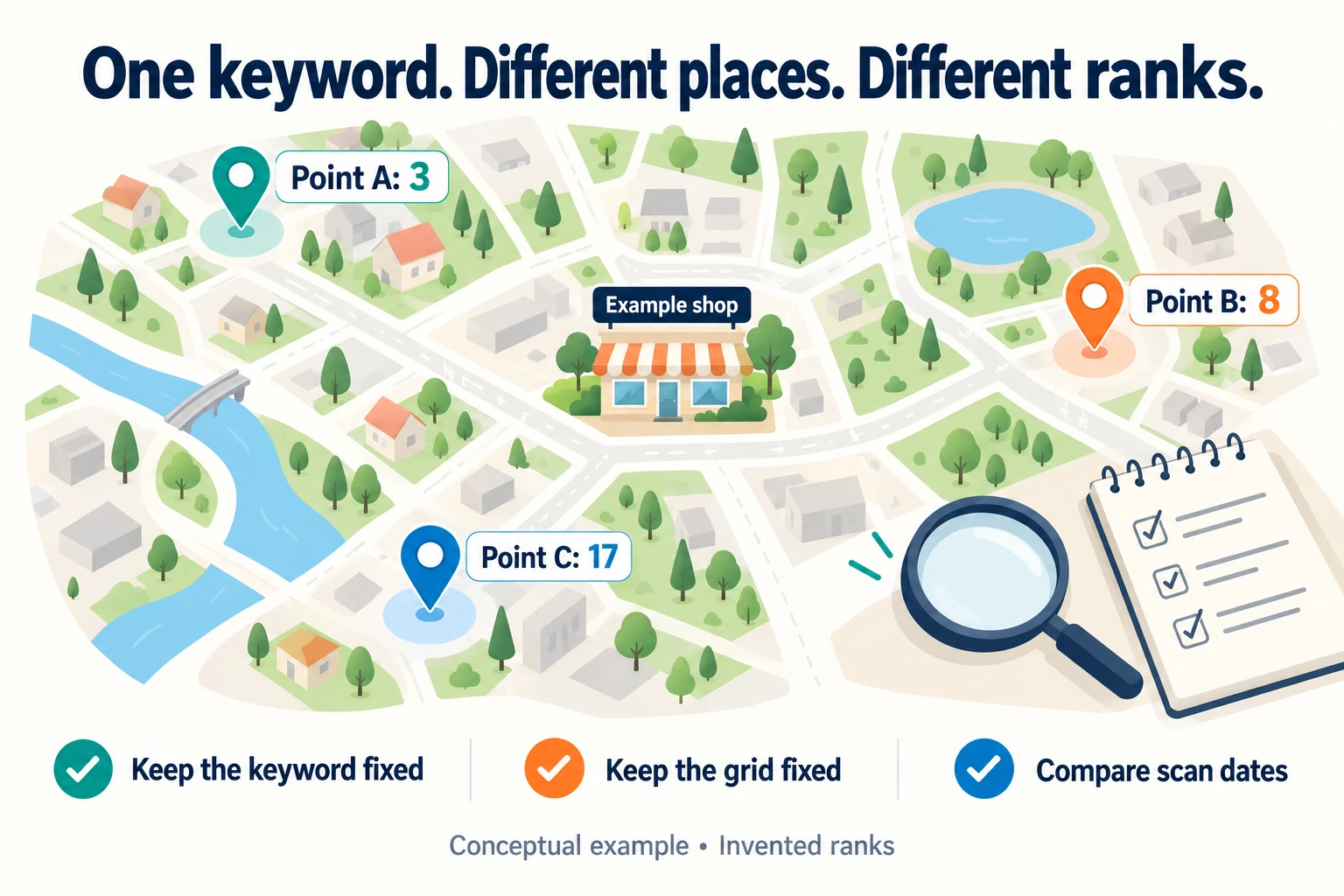
Think of a rank as an observation with several labels attached: business, search phrase, search location, results surface and collection time. A number without those labels is hard to use.
A single-location checker gives you one viewpoint. A geo-grid checker repeats the search at a collection of map points. A rank tracker adds repeat scans and history. Vendors sometimes use these names interchangeably, so look at what the plan actually includes.
Google explains that local results depend mainly on relevance, distance and prominence. That’s why there isn’t one permanent, city-wide position for a business. A grid helps you sample the variation; it doesn’t reveal every customer’s personalized experience. See Google’s explanation of local ranking.
Maps results, the local pack and website rankings are different
- Google Maps results: the businesses returned in Maps for the chosen search.
- The local pack: the compact group of business listings shown within a Google Search results page. Record it separately from the longer Maps list.
- Website rankings: the positions of web pages in search results. These measure a different result type from your Business Profile listing.
Google Search Console’s Search results report measures your website’s search performance. Its average position is not a neighborhood-by-neighborhood Business Profile rank report. A website can lose impressions for one query while its Maps listing follows a different pattern.
Business Profile Performance is different again. It reports profile discovery and interactions such as website clicks, direction requests and clicks on the call button. Google notes that its performance data can include organic results and Google Ads. Use those outcomes alongside a rank grid, not as interchangeable measurements. Google describes the available Performance metrics here.
Free and paid Google Maps rank checkers compared
These are documented options, not a tested league table. Prices are the published US-dollar offers we observed, before any applicable tax unless stated. Billing cycles, account eligibility and allowances matter, so confirm the final terms before subscribing.
| Option | Free access or starting price | Useful for | Important limit |
|---|---|---|---|
| BrightLocal Local Search Results Checker | 10 free searches per day without a paid subscription | Checking a specific keyword and search location | A localized results lookup, separate from its paid grid-tracking product |
| Localo | Free checker; 14-day platform trial. Single Business displayed at $39/month billed annually, plus VAT | A quick snapshot or tracking alongside profile-management tools | Free checker access does not establish unlimited ongoing monitoring |
| Semrush Map Rank Tracker | Free: 1 campaign and 50 credits. Standalone Basic: $30/month and 4,000 credits | A small initial grid, then repeat credit-based scans | Free plan: 1 keyword, 5×5 grid, manual or weekly scheduling |
| GTrack by Wiremo | One trial scan without signup; free plan with 200 credits/month. Starter: $19.99/month | Trying grid checks with a recurring free allowance | Free grids up to 5×5; scheduled scans start on the paid Starter plan |
| Local Falcon | 100 signup credits; Starter $24.99 billed monthly with 7,500 credits | Planning repeated scans around a credit budget | Signup credits are not a recurring free plan; subscription credits expire with the billing cycle |
| BrightLocal Track | 14-day trial without a card. One location: $41 monthly or $369 billed annually | Grid tracking within a broader local SEO reporting package | Standard Local Search Grid reports have 5 keywords; the separate Local Rank Tracker’s 100-keyword allowance is different |
BrightLocal’s free-search allowance is documented in its checker overview. Its grid keyword limits also describe paid add-ons. Don’t compare a single-location keyword allowance with a geo-grid allowance as though they buy the same work.
Localo’s free checker is different from its platform trial
Localo still publishes a free rank-checker page. Its checker documentation describes snapshot checks and a 10-search daily limit. That article concerns the embeddable checker, so confirm the limit shown in the specific interface you’re using.
For the wider platform, Localo documents a 14-day trial, possible profile or workspace restrictions, and limited features after the trial without a plan. Its pricing page shows the annual-billing offer listed above. The displayed $39 monthly equivalent totals $468 for a year, plus VAT; check the billing commitment before subscribing. The older promise of free automatic monitoring, protection and a website should not be treated as a current unlimited bundle.
Semrush Map Rank Tracker and Local plans have different allowances
The standalone Map Rank Tracker offer and the broader Semrush Local packages are separate comparisons. The Local plan guide lists 375 Map Rank Tracker credits for Base and 1,225 for Pro. Those are not the standalone Basic plan’s 4,000 credits.
At one credit per point, a 5×5 scan of one keyword uses 25 credits. The free 50-credit allowance therefore covers two such scans, not four weekly runs. A scheduling option is not a promise of enough credits to fund it.
Check the exact product, included campaigns, locations and credits in your account before upgrading. A familiar brand name or an existing SEO subscription doesn’t tell you which Maps allowance you have.
Other first-page tools are worth checking with their limits
GMB Radar advertises 300 signup credits and a $15/month Standard plan with 5,000 monthly credits for up to 10 businesses. GBPly advertises 10 free checks a month with a free account, using a 25-point grid. These may be worth comparing when their allowances suit your workload; we haven’t validated their scan accuracy.
Also check installation and account permissions. The Local Business Rank Tracker Marketplace listing identifies a third-party developer and requests permissions including spreadsheet access and sending email. A listing on a Google marketplace doesn’t make a tool a Google-built ranking service. Review the developer, permissions, privacy policy and paid limits before connecting it.
How to check Google Maps rankings for free
If you’re checking one business and a few phrases, begin with a small, repeatable baseline. You don’t need to buy a large monthly plan to find out whether you’re selecting the correct listing and search terms.
- Choose a customer search. Use a service or product you genuinely offer, such as “bike repair” or “emergency plumber.” Keep brand-name searches in a separate group because they answer a different question.
- Choose the viewpoint. Note the real area being checked. In a localized checker, enter the search location requested by the tool and select Maps results.
- Identify the exact business. Match the listing’s address or Maps URL. Similar names, branches and practitioner listings can lead you to track the wrong profile.
- Record the observation. Save the keyword, location, date, result type and position. Separate sponsored placements from the unpaid list.
- Repeat from relevant viewpoints. Check a few places where customers actually need your service. Use the same viewpoints next time rather than selecting whichever produces the best number.
A manual search in the Maps app is useful as a spot check, but describe it honestly: it is what that device displayed at that time. Don’t treat an incognito window or a city name added to the query as proof that you’ve reproduced another customer’s exact location. Google can estimate location from several signals, including an IP address. Google explains how search location works.
For a first keyword list, our keyword research guide can help you organize ideas. For this particular task, prioritize services and places relevant to the business over broad phrases with impressive search-volume estimates.
How to set up a useful geo-grid rank tracker
Before pressing the scan button, write down what you want to learn. “Can people in our delivery area find us for our main service?” is a better brief than “make the map green.”
1. Confirm the listing and keyword set
Select the exact profile, then start with a short list of commercially relevant searches. Keep the wording unchanged between comparison scans. “Plumber,” “emergency plumber” and “plumber in Bristol” are different searches, even if they feel closely related.
For a business with several branches, make a separate measurement plan for each location. Don’t let a successful central branch hide weak visibility around another branch in a combined average.
2. Set the grid area and points deliberately
A 5×5 grid contains 25 sample points. Increasing the number of points and increasing the area are different decisions: a denser grid can examine the same neighborhood in more detail, while a wider grid reaches farther away.
Check how the selected tool defines radius, spacing and distance. Don’t assume a distance field means the same thing in every product. Inspect the map before running it, especially around coastlines or areas the business doesn’t serve.
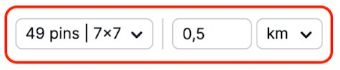
BrightLocal’s grid documentation describes custom points that can skip irrelevant areas. That’s useful, but keep the chosen points stable for comparisons. Removing low-ranking points from the next report can improve the average without the business improving anywhere.
3. Estimate the scan cost before scheduling
For a tool charging one credit per point per keyword, estimate the basic scan workload as:
Points × keywords × scan runs × business locations.
For example, a 5×5 grid, four keywords, four scheduled runs and one business location uses 25 × 4 × 4 × 1 = 400 point-keyword checks. This is an invented planning example, not a measured campaign. A calendar month can contain five weekly runs, so leave room for that and for manual rechecks.
Local Falcon’s pricing explanation defines a credit as a map point and notes that optional AI analysis has a separate credit cost. Other vendors can price campaigns, reports or features differently. Check their own calculator and allowances instead of applying this formula to every plan.
4. Save a comparable baseline
Record the grid center, active points, units, keyword spelling, business identifier, language and any device or results settings the tool exposes. Save the completed report with its date and timezone.
A weekly scan is a reasonable starting schedule for routine monitoring, provided it fits your budget. That’s an editorial starting point, not a Google requirement. Daily scans can help investigate a specific problem, but more frequent collection doesn’t automatically produce a more useful decision.
How to read a rank grid without misreading it
Start with the individual points, then use summary metrics to describe the pattern. Ask where the weak area is, which keyword is affected and whether the same competitors appear there.
- Top-three coverage: the proportion of sampled points where the listing appears in positions one to three. It is not the percentage of customers, calls or revenue you won.
- Average rank: check how missing results are handled before comparing tools. Semrush uses 21 when a position falls outside its top-20 range.
- Share of voice: a vendor-defined visibility metric. Semrush describes a rank-weighted measure; it isn’t a direct count of all local searches or customer visits.
- Not found: usually a statement about the scan’s result depth and settings. It doesn’t by itself prove the profile was removed from Google.
The Semrush metric definitions and Keyword report guide explain its report views. Use equivalent definitions when comparing dates, and avoid combining differently calculated scores from different platforms.
Here’s a simple hypothetical example. If a listing appears in the top three at 8 of 25 points, coverage is 32%. If the next comparable scan shows 12 of 25, coverage is 48%. That’s a gain of 16 percentage points across those sampled locations. It doesn’t mean sales rose by 16%, and it doesn’t establish which marketing change caused the movement.
What to do if your Google Maps rankings drop
- Check the measurement first. Did the listing, keyword, radius, active pins, language, schedule or results surface change? Did the scan finish successfully?
- Look for a pattern. One changed point deserves a different response from a sustained decline across several important queries and locations.
- Inspect the real profile. Check business details, categories, hours, website links and any visible account notices. Correct factual errors rather than making speculative changes to every field.
- Compare customer outcomes. Review relevant Business Profile interactions and your own enquiry or booking records over an appropriate period. Rank movement alone doesn’t tell you whether the business gained or lost customers.
- Document each improvement. Note what changed and when, then keep the measurement setup stable. Treat later movement as a signal to investigate, not automatic proof of causation.
Google recommends accurate, complete information, verification and helpful review responses. You can’t pay Google for a better unpaid local ranking. Avoid turning a tracking report into a promise of guaranteed top-three placement. Read Google’s local visibility guidance.
Keep the business name consistent with its real-world name. Don’t add cities or services solely to influence rankings, create fictitious locations, or change the address just to center a scan. Google’s Business Profile representation guidelines explain the naming and location rules.
Ask genuine customers for honest reviews without incentives. Buying or rewarding reviews is not a sensible response to a disappointing grid. Google’s review guidance specifically prohibits incentives for posting, changing or removing reviews.
A simple local rank-tracking report template
Keep one record per business, keyword and scan date. The following fields make a report easier to interpret later:
- Business name and exact listing identifier or Maps URL
- Keyword and result surface, such as Maps rather than website results
- Scan date, time, timezone and tool
- Grid center, area, point count and active-point configuration
- Top-three coverage, average rank and the tool’s missing-result rule
- Important competitor or neighborhood changes
- Work completed since the previous scan and any measurement changes
- Relevant customer outcomes, reported separately from ranking metrics
Write a short interpretation underneath: what changed, where it changed and what you plan to investigate. “Visibility improved around the east side for bike repairs” is more informative than presenting one green percentage without its context.
Frequently asked questions
Is there a free Google Maps rank checker?
Yes. Free localized searches, limited grid plans and trial credits are available. Check whether the allowance renews, whether an account is required and whether saved history or scheduled scans are included. A free signup is not necessarily free ongoing monitoring.
Does Google offer an official Maps rank tracker?
Google provides Maps, Business Profile Performance and Search Console, each with a different purpose. The third-party geo-grid products in this guide are not Google’s own neighborhood rank-tracking service. Marketplace availability alone doesn’t change who develops a tool.
Why does the rank checker disagree with my phone?
You may be comparing different locations, times, queries, results surfaces or personal contexts. First match the settings you can verify. A discrepancy deserves investigation; it doesn’t automatically prove that either observation is fabricated.
Does “not found” mean my business is unindexed?
No. Check the selected listing, keyword, scan status and search depth first. A business missing from one tool’s captured range may still appear for another search or location. Verify any suspected profile problem directly in the relevant Google interface.
Can a service-area business use a grid tracker?
Yes, where the tool supports the listing type. Follow its documented selection method and keep the profile’s address privacy intact. BrightLocal’s report setup guide, for example, directs service-area businesses to its Google Maps URL option. You don’t need to invent a storefront for tracking.
Will a paid rank tracker improve my position?
Tracking gives you evidence about visibility. Any additional optimization features are separate actions with their own permissions and risks. Choose a tool for the information you need, then make accurate, policy-compliant improvements. Neither a subscription nor a larger grid guarantees better rankings.
Final thoughts
Start with one correct listing, a few useful keywords and a clearly defined area. Use a free check to establish the basics, then pay for repeat scans or reporting only when you need them. The goal is a reliable view of where customers can find you, supported by real enquiries and business results.